
The moment I dropped those $600, I actually felt a twinge of excitement: finally, I could chain together all my scattered automation workflows—messages come in, data gets cleaned, calls to LLMs happen, responses go back to Slack, sync to Notion, then toss into a database, ideally with auto-retry, auto-alerts, and auto-generated weekly reports.
Everyone online says n8n is the "Swiss Army knife of workflows" and "the central hub of AI automation." I even rehearsed my future self in my mind: sipping coffee, watching workflows run themselves, like a general commanding thousands of troops.
Reality was: I first spent three days as a DevOps engineer, then two days as an API debugger, followed by a full week as a "JSON processor." The moment the workflow finally ran, I felt no rush of satisfaction—only a weary clarity: it's powerful, yes, but its power is "hard," like a machine tool. Those who know how to use it see explosive efficiency; those who don't just get cut.
This article isn't a hit piece on n8n—it's my "demystification notes" bought with $600: Who is it really for? Where are the pitfalls? And—how do you use it without getting bitten back?
01 You Think You're Buying Automation, But You're Actually Buying "Complexity"
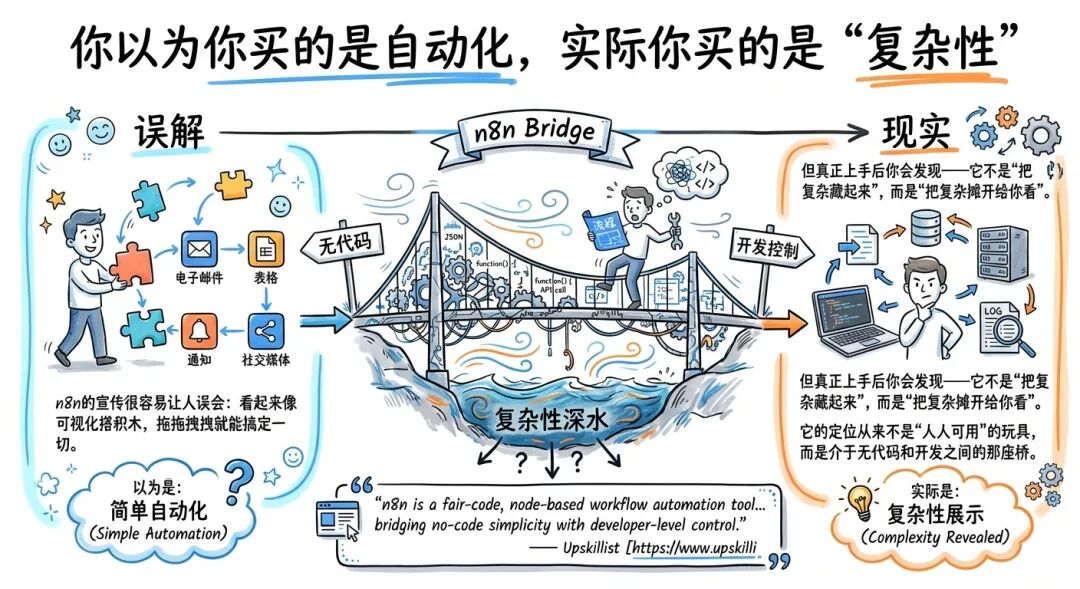
n8n's marketing easily creates a misunderstanding: it looks like visual building blocks, drag-and-drop to get everything done. But once you actually start using it, you'll realize—it doesn't "hide complexity," it "spreads complexity out in front of you."
Its positioning was never a "toy for everyone," but rather a bridge between no-code and development. The other end of the bridge is freedom, yes, but the bridge is windy, with deep water below.
"n8n is a fair-code, node-based workflow automation tool… bridging no-code simplicity with developer-level control." — Upskillist https://www.upskillist.com/blog/n8n-review/
The first cut of demystification is when you suddenly realize: workflow automation doesn't automatically become simple—it just trades "the complexity of writing code" for "the complexity of understanding data flow."
Especially when what you want to do isn't just "receive email → forward message," but rather:
Multi-branching (IF/ELSE)
Loops (batch pagination, iterative processing)
Parallel/merge operations
Exception handling and retry strategies
Multi-system permissions and credential management
LLM calls and context assembly (RAG, Embeddings)
n8n's node canvas makes all this "visible," but doesn't make it "lighter." Each node you drag is essentially pushing system complexity one step further.
What's even more painful: you can't win by "brute-force dragging nodes." You must understand JSON, APIs, authentication, error codes, idempotency, latency, and timeouts. Otherwise the workflow won't just fail to run—it will run but be unstable.
This is why many people collapse after spending money: you thought you were buying time savings, but you actually bought an engineering system that requires you to do homework.
02 Where Did That $600 Actually Go? The Real Burn Is "Trial-and-Error Costs"
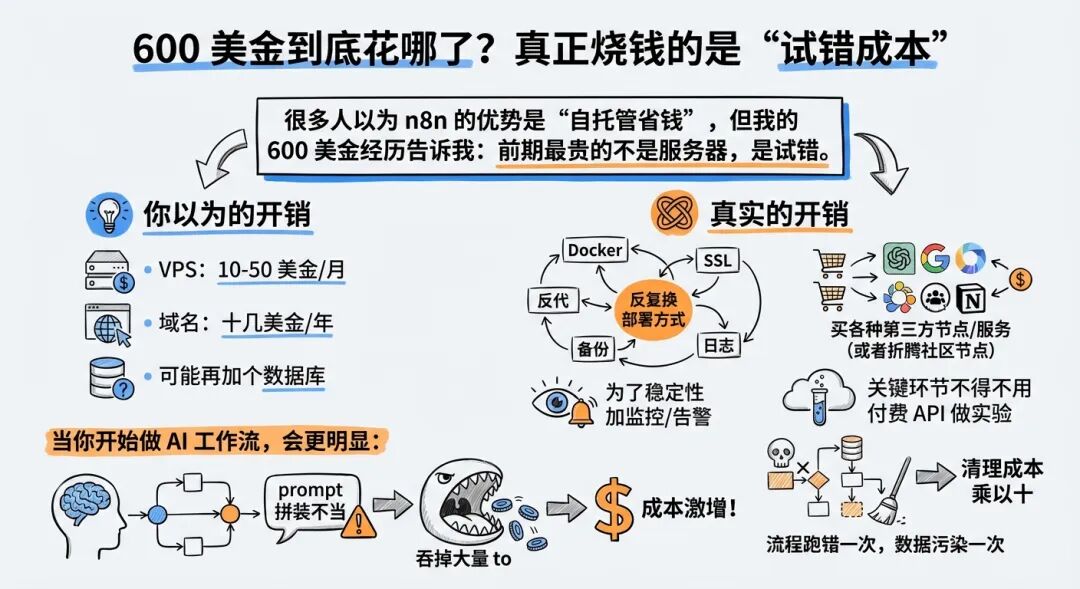
Many people think n8n's advantage is "self-hosting saves money," but my $600 experience taught me: the most expensive part upfront isn't the server, it's trial and error.
What you think the expenses are:
VPS: $10-50/month
Domain: $10+/year
Maybe add a database
The real expenses:
Repeatedly changing deployment methods (Docker, reverse proxy, SSL, backups, logging)
Buying various third-party nodes/services (or wrestling with community nodes)
Adding monitoring/alerts for stability
Having to use paid APIs for critical testing
One workflow mistake, one data corruption, cleanup cost times ten
When you start doing AI workflows, it becomes even more obvious: one improperly assembled prompt devours massive tokens; one uncontrolled loop triggers upstream rate limiting; one poorly written error handler creates "partial success" states—the hardest to trace.
More realistically, n8n is indeed suited for complex logic, but this means you'll be more inclined to cram all complexity into it, eventually forming "mega-workflows" that debugging feels like untangling a ball of yarn.
So that $600 wasn't essentially "buying a tool," but rather "paying for the learning curve and trial-and-error process." If your budget is tight and time even tighter, n8n will likely give you an illusion: how come the more I automate, the busier I get?
03 What Makes n8n Most Captivating: It's Not a Tool, It's an "Orchestration Layer"
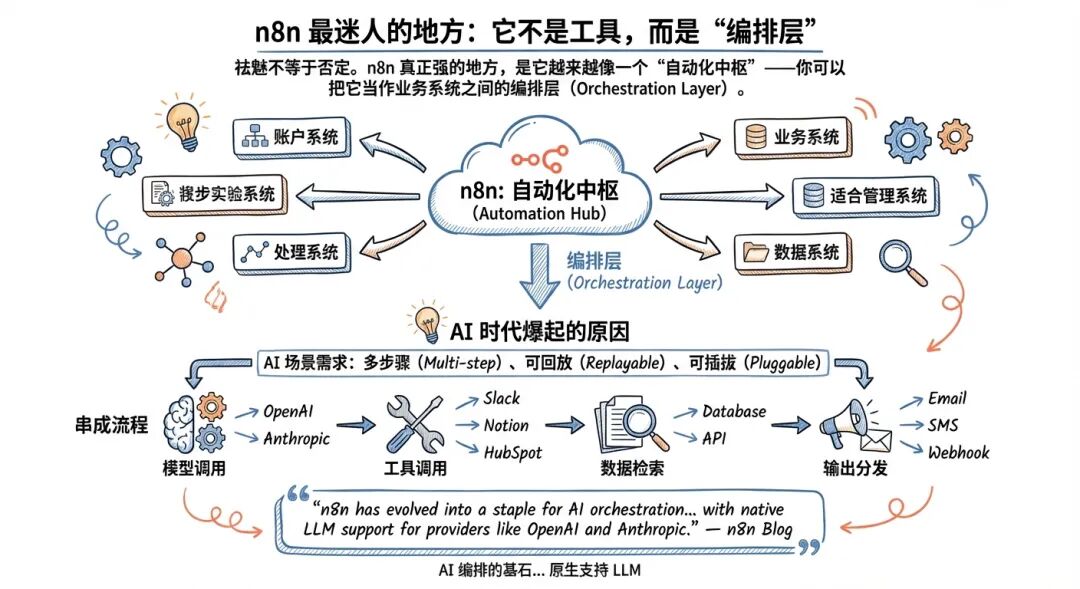
Demystification doesn't equal denial. What n8n is truly strong at is increasingly becoming an "automation hub"—you can treat it as an orchestration layer between business systems.
This is also why it exploded in the AI era: AI scenarios naturally need "multi-step, replayable, pluggable" pipelines, stringing together model calls, tool calls, data retrieval, and output distribution into workflows.
"n8n has evolved into a staple for AI orchestration… with native LLM support for providers like OpenAI and Anthropic." — n8n Blog https://blog.n8n.io/best-ai-workflow-automation-tools/
Its charm lies in:
Logic has no ceiling: branching, loops, parallelism, retries, sub-workflows—you can essentially move a small backend system's business logic onto the canvas.
API-friendly: any service accessible via API can be integrated; you don't have to wait for platforms to provide "official integrations."
Smoother AI pipelines: from trigger → retrieval → model call → structured output → write to system → notification, all can run in a unified execution trace.
The control of self-hosting: predictable costs, data control, permission control (provided you can actually secure it properly).
Even from market trend perspective, its growth isn't surprising: automation demand is rising, remote collaboration, AI deployment, system fragmentation—all pushing teams to find an "orchestration layer."
"n8n has surpassed 230,000 active global users as of late 2025." — FlowLyn https://flowlyn.com/blog/n8n-user-count-statistics-growth
In other words: n8n's value isn't in "making things easy," but in "making complex things manageable." What you need is a container that can hold complexity, not a magic wand that thinks for you.
04 What Really Demystified Me: That Wave of 2026 Security Vulnerabilities—Self-Hosting Isn't a "Get-Out-of-Jail-Free Card"
Many people talking about n8n describe self-hosting as a "safer, freer" choice: data in your own hands, credentials you manage, modify however you want.
But the wave of critical vulnerabilities exposed in early 2026 yanked me straight out of "self-hosting romanticism": you control the server, so you inherit all of the server's risks.
What's even scarier: the blast radius of these vulnerabilities perfectly fits n8n's usage pattern—n8n stores precisely massive amounts of sensitive information: API keys, webhooks, database credentials, internal system tokens, enterprise messaging permissions, even LLM keys.
Once compromised, it's not "workflow broke," it's "the entire automation hub is hijacked."
"Six n8n CVEs disclosed in one day… a clear signal of systemic security weaknesses." — Upwind Security https://www.upwind.io/feed/six-n8n-cves-one-day-workflow-security
Pillar Security's analysis of "sandbox escape" and other issues also emphasized the "high-privilege" nature of such workflow systems: it naturally sits at the boundary between enterprise data and the outside world—once attackers get in, the value is extremely high.
"Sandbox escape critical vulnerabilities in n8n… exposes… enterprise AI systems to complete takeover." — Pillar Security [https://www.pillar.security/blog/n8n-sandbox-escape-critical-vulnerabilities-in-n8n-exposes-hundreds-of-thousands-of-enterprise-ai-systems-to-complete-takeover]
The impact on me: from that day on, I no longer treat n8n as an "automation tool," but as a "production system."
What does a production system mean? It means you need to do:
Least privilege (who can edit workflows? who can see credentials?)
Credential isolation and rotation
Version upgrade strategy and rollback
Network isolation, reverse proxy, WAF, IP whitelisting
Audit logs, anomaly alerts
Testing and replay for critical workflows
If you don't do these things, what you're saving isn't cost, but rather "a bigger bill to pay in the future."
05 You Don't Need More Nodes—You Need "Engineering Methods for Using n8n"
After demystifying n8n, I actually became better at using it: because I no longer chase "stacking features," but pursue "maintainable, traceable, extensible."
Here's a set of engineering practices I later summarized, suitable for individuals/small teams (no mysticism, purely practical):
1) Break "Mega-Workflows" into Modules: Sub-Processes/Sub-Workflows
Don't cram all logic onto one canvas. Split it into three layers:
Trigger layer (Webhook/scheduled/message queue)
Processing layer (cleaning, rules, AI calls)
Output layer (write to DB, send messages, archive)
Make each layer an independent sub-process to reduce coupling. This way you won't feel like flipping through an entire phonebook when debugging.
2) Build "Observability" First, Then Talk Automation
You need to answer three questions:
What's the failure rate?
Which node is failing?
What does the failed data look like?
Set up logging, alerts, retry strategies first. Without these, your automation is just "appears to be running."
3) Treat Data Structure Like a Contract: Standardize Input/Output JSON
n8n's biggest pain point is actually "data morphing between nodes." What you should do:
Each sub-process clearly defines input fields and output fields
Unified naming for critical fields
Use fixed structure to carry error information (error_code, error_message, raw_response)
This prevents a complete rewrite when you add or swap nodes later.
4) Control Cost and Risk for AI Nodes
If you're connecting LLMs in n8n, recommend doing this from the start:
Token budgeting (summarize long texts before reasoning)
Prompt templating (version management)
Structured outputs (JSON schema / strict constraints)
Failure fallback (degradation strategy when model times out or rate-limits)
n8n's AI is powerful, but AI's uncertainty also amplifies workflow instability. You must cage the "randomness."
06 Who Should Use n8n? Who Should Stop Right Now?
The most important thing after demystification is to judge: should you actually keep investing?
People Who Fit n8n (Recommended to Continue)
You've been blocked by Zapier/Make's "logic ceiling"
You need multi-system, multi-step, strong branching, strong fault tolerance
You're willing to learn API / JSON / basic DevOps
You treat automation as a "long-term asset" and are willing to maintain it with engineering practices
You're doing AI orchestration: RAG, Agents, multi-tool pipelines
Some service companies succeed with n8n essentially because they treat it as "project delivery," not a "drag-and-drop toy."
People Who Don't Fit n8n (Recommended to Cut Losses)
You only want ultra-simple automation (two or three steps)
You want "mindless drag-and-drop with instant results"
You don't have the energy to maintain deployment, upgrades, security
You can't accept "debugging is daily" reality
Your business heavily depends on stability, but your team lacks engineering capability
Many comments will say "n8n is intuitive," and others will say "n8n is frustrating." Both are correct: the canvas is intuitive, the frustration is the complex system itself.
07 Conclusion: That $600 Wasn't Wasted—It Bought Away My Illusions
I still use n8n now, but my usage has completely changed:
I no longer fantasize about "one workflow liberating my entire life," but treat it as automation infrastructure that needs design, monitoring, and iteration.
What that $600 ultimately bought was my naive imagination about "automation tools"—thinking that just switching tools would make everything smooth. The truth is: tools don't eliminate complexity for you; they just make complexity appear in another form.
If you're about to dive into n8n, I'd rather give you a plain truth:
n8n's threshold isn't installation, but whether you're willing to treat it as engineering.
Willing? It's a productivity amplifier. Unwilling? It's a time black hole.
Have you also stepped on n8n's landmines? Or how much money did you spend before "waking up"?
Welcome to tell me in the comments: what was your most painful workflow crash—I'd also like to see what kind of "tuition" everyone's $600 went toward.