Those who know me, my cloud shareholders, probably know that I generally produce articles around "AI tools," around "one-person companies," and around "Vibe Coding."
This is my first time with this kind of topic. What really surprised me is: a Haidian district-level official WeChat article actually got into organizing a Hackathon‼️Haidian Hosts "Lobster" Competition! Billions of Tokens + Millions in Prize Money‼️
Because I previously worked at Baidu, where they held Hackathons every year, I initially thought this competition was unique to the Bear Factory. After leaving and staying home unemployed, I discovered that these happen all over the world. So this article is kind of an explainer! To let you know:
1) What is a Hackathon?
2) What are you competing on in a Hackathon?
3) What are international Hackathons doing?
4) How does this compare to domestic Hackathons?
5) A breakdown of the Haidian Hackathon competition content
It's probably around mealtime now, so you can read while eating!
But one thing needs to be stated upfront: all content comes from the internet. If you don't like it or think it's nonsense, leave your opinion and I'll correct it immediately.
01 What is a Hackathon? Building a Product in 48 Hours
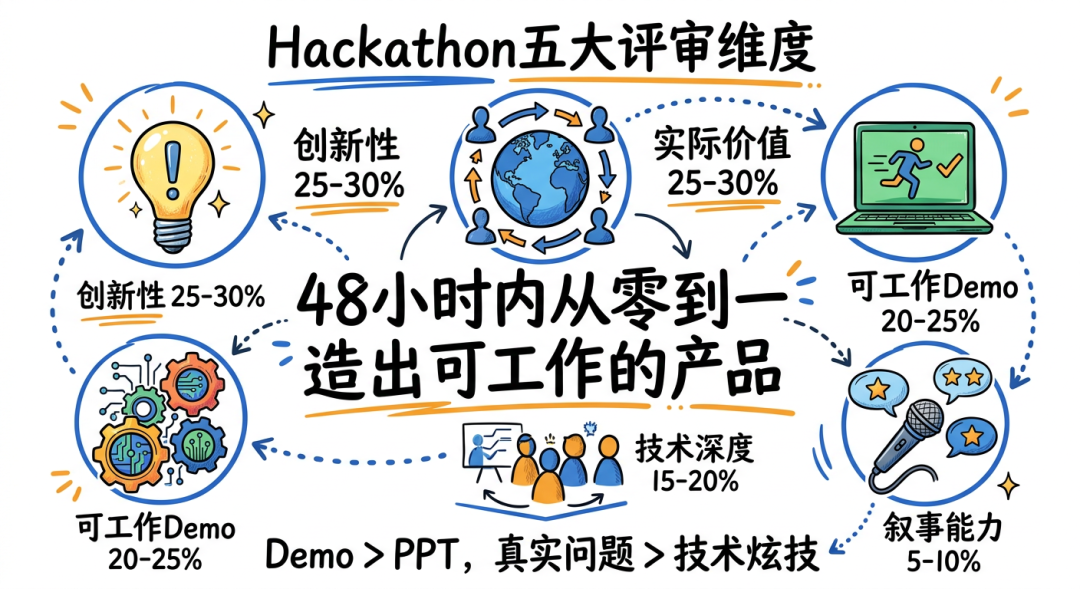
Hackathon = Hack + Marathon. Typically within 24-48 hours, participants (individuals or small teams of 2-5 people) build a working software/hardware prototype from scratch and ultimately present it live to judges.
What are they judging?
Dimension: Innovation Weight: 25-30% Description: Is there a "Wow moment"? Has anyone done this before?
Dimension: Impact Weight: 25-30% Description: What real problem does it solve? Who does it help?
Dimension: Working Demo (Execution) Weight: 20-25% Description: Can it run on the spot? Can judges try it themselves?
Dimension: Technical Depth Weight: 15-20% Description: Is the tech stack appropriate? Are there technical highlights?
Dimension: Storytelling/Pitch Weight: 5-10% Description: Can non-technical judges understand it in 30 seconds?
Key Characteristics:
Extremely short timeframe (24-48h), competing on "it works" not "perfection"
Demo > PPT, live demonstration > concept explanation
Solving real problems > technical showboating
Team collaboration > individual heroics
02 Chinese Arena: From Web3 to AI Hardware
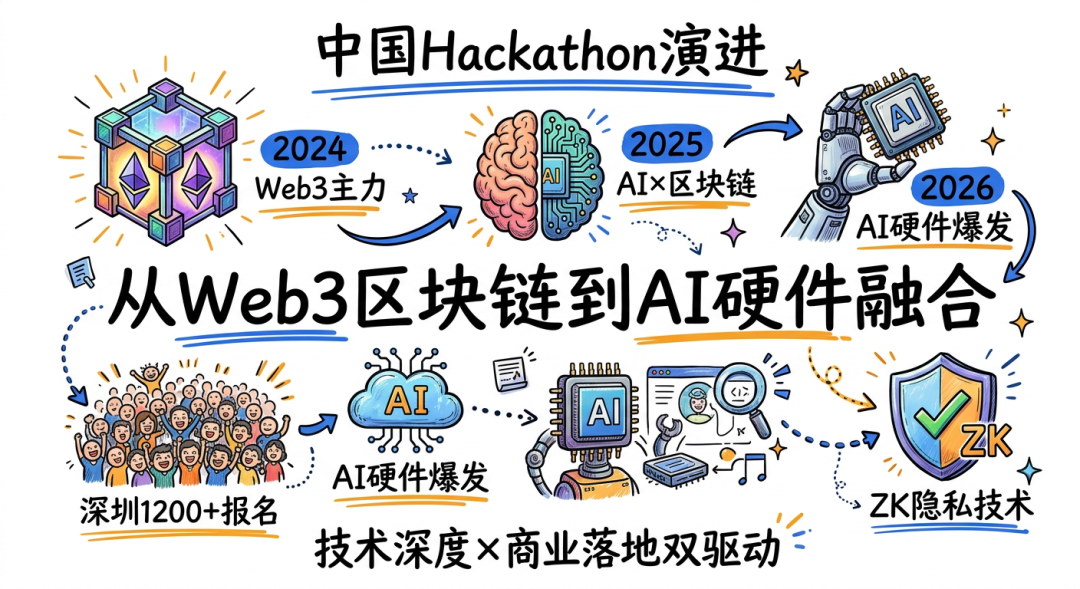
Major Events and Winning Trends
2.1 ETHGlobal Bangkok 2024 (Asia-Pacific, Chinese developers participating)
Winning Project: NexusPay What it does: Cross-chain USDC instant payment Tech: Circle CCTP + Ethereum L2 Why it won: Solves real cross-chain payment pain point
Winning Project: Zubernetes/ZK8S What it does: First TEE ZK container orchestrator Tech: ZK Proof + Kubernetes Why it won: Extremely high technical depth, won multiple awards
Winning Project: LibreNews What it does: Censorship-resistant news feed Tech: On-chain storage + immutable Why it won: Strong social value narrative
Winning Project: DegenOS What it does: Decentralized operating system Tech: Cartesi Rollups + Avail DA Why it won: Innovative concept + multiple awards
Winning Project: credti What it does: Web2 credit → Web3 uncollateralized lending Tech: ZKtls + credit data Why it won: Cross-world bridging innovation
2.2 ETHGlobal Taipei 2025 (33 projects)
Zhat's Me: ZK proof ticket ownership (privacy protection)
NameFlow: AI + domain identity management
SoulChain: Thoughts/voice → AI NFT
Tech trends: ZK proofs, AI+blockchain, identity management, privacy protection
2.3 ETH Shanghai 2025 (China's largest Web3 Hackathon)
Organizers: Wanxiang Blockchain + ETHPanda + PANews + TinTinLand
Date: October 18-21, 2025, expecting 800+ attendees
Tracks: AI x ETH / DeFi x Infra / Public Goods x Open Source
Winners: Not yet announced
2.4 VibeHacks Series (2025 new trend)
Organized by VibeFriends + SegmentFault
24-hour Vibe Coding hackathon, lowering programming barriers
Reflects 2025 "Vibe Coding" trend — AI assisting non-technical people to rapidly build products
2.5 Shenzhen OpenClaw x AI Hardware Demo Competition (2026-03-06)
Project: "Iron Lobster" What it does: One command controls entire experimental equipment workflow (heating, oscillation, recording, email) OpenClaw capability: Multi-device coordination, system control
Project: Watcher Robot What it does: Open-source desktop robot (voice activation + face tracking + task execution) OpenClaw capability: Voice control, Agent execution
Project: Smart Glasses What it does: Voice database queries + report generation OpenClaw capability: Voice interaction, database integration
Project: Robotic Arm Control What it does: 9 servos + camera + face recognition OpenClaw capability: Hardware control, vision integration
Common Characteristics of Chinese Hackathon Winners
Technical depth prioritized — ZK container orchestration won multiple awards; more cutting-edge tech = more favored
Web3/blockchain still the main track — ETH Shanghai is the benchmark
AI+X integration trend obvious — AI x ETH became a new track in 2025
Hardware integration popular — Shenzhen meetup had 1,200+ registrations, high enthusiasm for hardware projects
Solving actual business problems — Cross-chain payments, uncollateralized lending, and other real needs
Leveraging sponsor tech stacks — Using sponsor APIs/SDKs significantly increases winning probability
03 US Arena: Social Impact is King
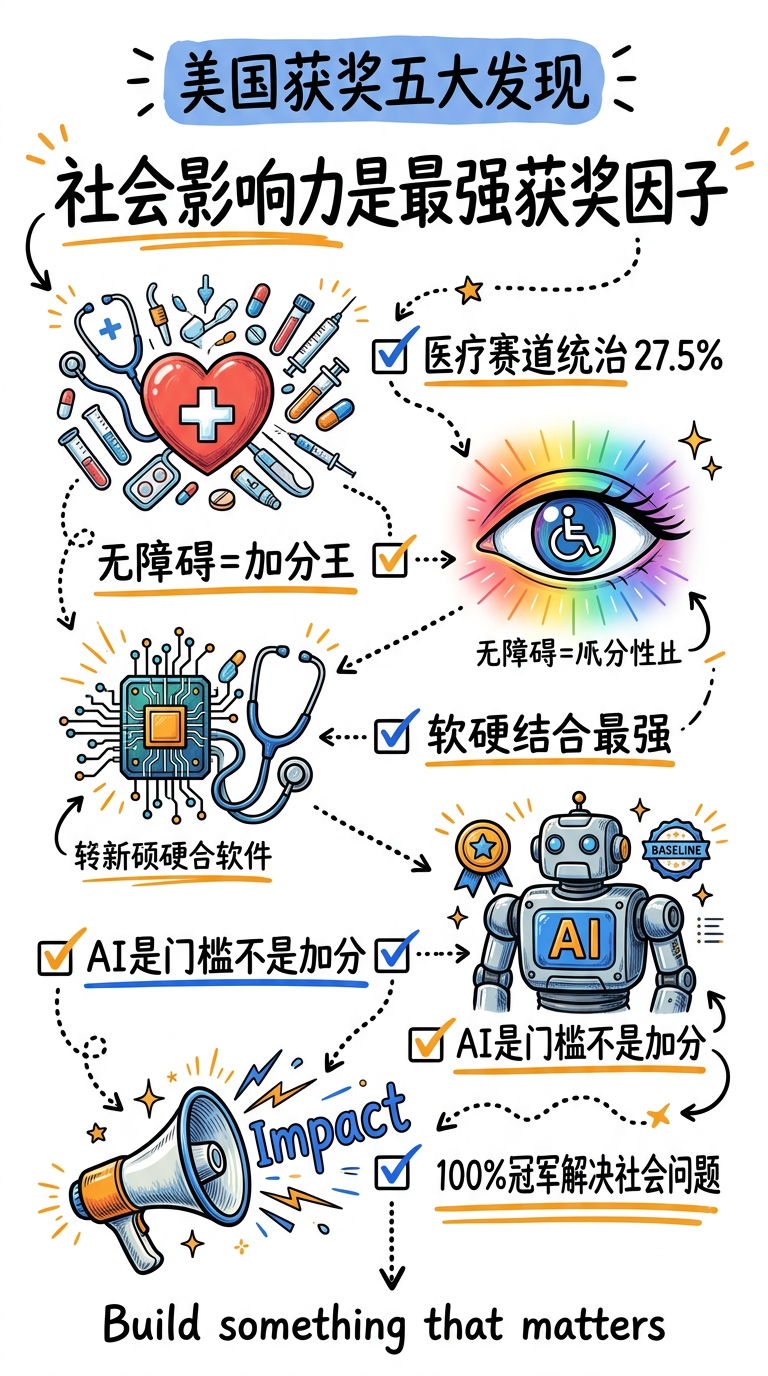
Detailed Winner Data (6 competitions, 40+ winning projects)
3.1 TreeHacks 2025 (Stanford) — Most complete data
Scale: 1,000+ participants, 257 projects, $150K+ prize pool
Award: Grand Prize $11K Project: HawkWatch What it does: AI video surveillance, real-time crime/threat detection Tech stack: Next.js + Gemini VLM + TF.js Problem solved: Security monitoring requires 24/7 human monitoring
Award: Most Impactful Project: Hearti What it does: 2D heart MRI → 3D model + AI diagnosis of congenital heart disease Tech stack: React + PyTorch + LumaAI + ElevenLabs Problem solved: Heart disease diagnosis relies on scarce experts
Award: Edge AI $10K Project: SurviveX What it does: Offline survival assistant (Apple Vision Pro + Llama 3.2) Tech stack: ExecuTorch + SwiftUI + LORA Problem solved: Emergency survival in no-network environments
Award: Web3 $7K Project: ECGo What it does: Portable ECG device + AI arrhythmia diagnosis (3-second sampling) Tech stack: ESP32 + CNN Transformer + Streamlit Problem solved: Heart monitoring in remote areas
Award: Best AI Agents $8K Project: MediLedger What it does: Decentralized drug inventory privacy queries Tech stack: Merkle + ZK-PTLS + EigenDA Problem solved: Privacy issues in inter-hospital inventory sharing
Award: Tesla Prize Project: HorizonX What it does: 2B VLM runs on phone, navigation for visually impaired Tech stack: WebGPU + Next.js Problem solved: Safe travel for visually impaired
Other highlights: PUSHPA (drone wildfire prevention), BrailleBot ($15 braille printer), BlinkAI (eye-blink Morse communication)
3.2 PennApps XXV (UPenn)
Award: Best Overall Project: SoundSheild What it does: Autism noise reduction wearable (spectral subtraction + voice preservation) Tech: Raspberry Pi + librosa + OpenCV
Award: Best Healthcare Project: Snapill What it does: AI medicine bottle scanning + drug interaction warnings Tech: React Native + Roboflow + Flask
Award: Best Education Project: Rally AI What it does: AI connecting politicians and voters
3.3 LA Hacks 2025 (UCLA, 172 projects)
Alto: Autonomous mobile bug fixing
Lumos: AI glasses help Alzheimer's patients recognize loved ones
Pulse: AR glasses guide CPR emergency aid
Delphi: Voice-driven web browser (for visually impaired users)
3.4 BoilerMake XII (Purdue)
Fluention: AI speech therapy (lip/tongue analysis + pronunciation training)
Site Sentinel: AI construction site safety monitoring (YOLOv8 + PPE detection)
3.5 HackDuke 2025 (Duke — "Code for Good")
Unified Fire: Firefighter structural intelligence system (3D buildings + FPGA collapse detection)
Common Characteristics of US Hackathon Winners
Five Core Findings
1. Social impact is the strongest winning factor
100% of Grand Prizes solve quantifiable social problems
HawkWatch → public safety, SoundSheild → autism, Hearti → heart disease
Pure technical showboating rarely wins top prizes
2. Healthcare is the dominant track
Accounts for 27.5% of winning projects, absolute first
Judges naturally believe healthcare projects have the greatest potential impact
3. Accessibility is a bonus king
Projects for disabled groups have far higher winning rates than average
Built-in "moral correctness" + technical challenge double bonus
4. Hardware + Software hybrids are strongest
ECGo (ESP32+AI), SoundSheild (RPi+CV), Unified Fire (FPGA+Web)
Building a software-hardware combined prototype in 36 hours = demonstrates exceptional team capability
5. AI is baseline, not a bonus
85%+ winning projects use AI, key is what scenario it's used in
Edge AI is a 2025 new trend (SurviveX $10K, HorizonX)
Grand Prize Formula
Grand Prize = Real social problem x Working demo x Technical "Wow Moment" x Clear 30-second narrative
04 China-US Hackathon Differences: Two Completely Different Winning Logics
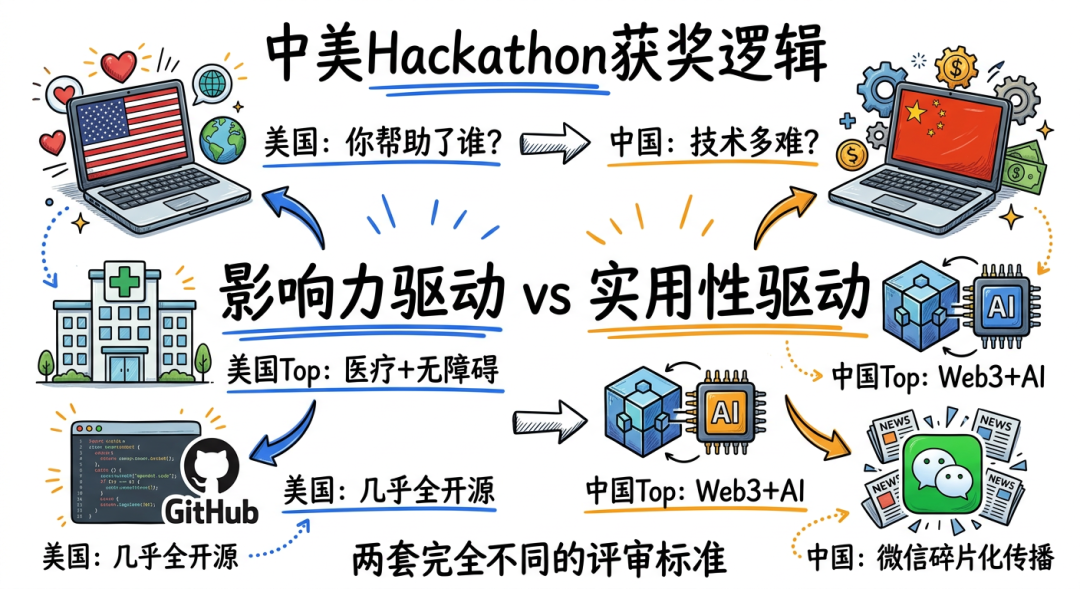
Dimension: Highest value orientation US: "Build something that matters" (social impact) China: "Build something that works/sells" (practicality/commerciality)
Dimension: Judge preference US: "Who did you help? What did you change?" China: "How hard is the tech? How does it land?"
Dimension: Highest winning rate track US: Healthcare + Accessibility China: Web3/blockchain + AI applications
Dimension: Hardware projects US: High winning rate (software-hardware combination sought after) China: Rising (Shenzhen hardware meetup extremely popular)
Dimension: AI usage US: AI serves specific social scenarios China: AI+X integration (AI+Web3, AI+Vibe Coding)
Dimension: Demo culture US: Extremely strong (must run live) China: Increasingly important, but still accepts concept demonstrations
Dimension: Web3/blockchain US: Active at ETHGlobal and similar events China: Main track (explosive growth with policy support)
Dimension: Judge background US: Professors + VCs + engineers + nonprofits China: Corporate sponsors + technical experts + government
Dimension: Open source culture US: Almost all open source China: Gradually increasing
Dimension: Accessibility projects US: Extremely high winning rate China: Relatively niche
Dimension: Information dissemination US: Devpost/MLH international platforms China: WeChat official accounts, highly fragmented
Core difference summary
US: Social impact driven. Judging system revolves around Impact + Innovation + Execution. Winning works make people feel "the world is a bit better because of this."
China: Practicality and technical depth driven. More focused on technical difficulty, commercial viability, and integration with sponsor tech stacks. In 2026 with OpenClaw ecosystem explosion, actual value creation (not showboating) becomes the new standard.
05 AI Agent Era: OpenClaw Competition Winning Directions
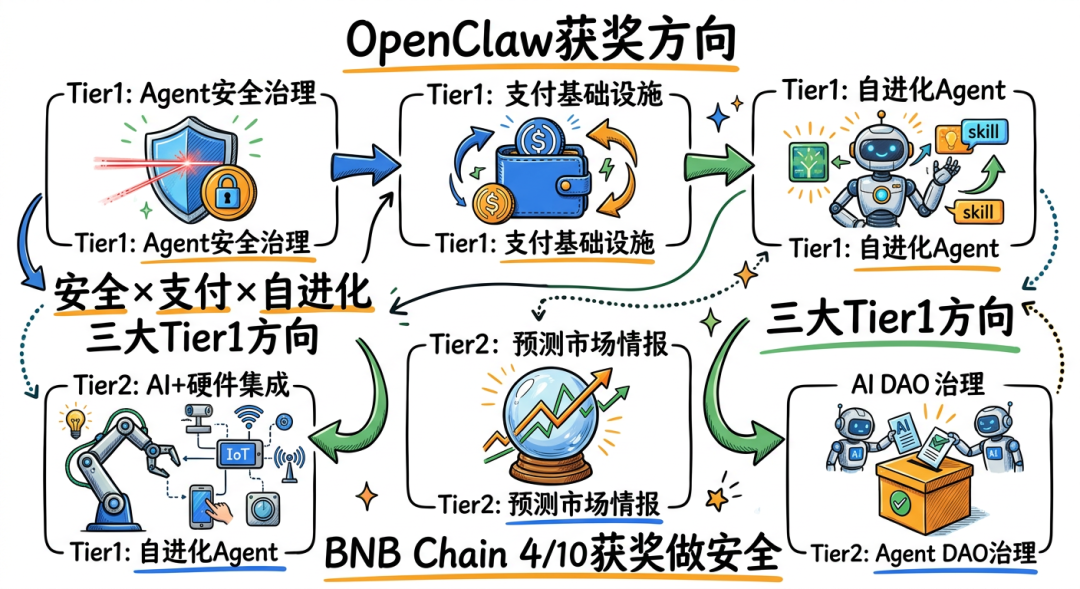
Confirmed 9 OpenClaw Hackathons
1 Competition: Circle USDC OpenClaw Hackathon Organizer: Circle + Moltbook Date: 2026-02-03~08 Prize pool: $30K USDC Winner data: Complete winner list available
2 Competition: BNB Chain Good Vibes Only Organizer: BNB Chain Date: 2026-02 Prize pool: $100K Winner data: 10 winners available
3 Competition: SURGE x OpenClaw Organizer: SURGE + Lablab.ai Date: 2026-02~03 Prize pool: $50K Winner data: Some projects known
4 Competition: Global Unhackathon Organizer: AI Tinkerers Date: 2026-02-28 Prize pool: None Winner data: Non-competitive
5 Competition: Movement @ ETHDenver Organizer: Movement Labs Date: 2026-02-19 Prize pool: M4 Mac Mini Winner data: Not found
6 Competition: HackIndia Organizer: HackIndia Date: 2026-03-06~28 Winner data: In progress
7 Competition: London Build the Future Organizer: OpenClaw Experts Date: 2026-03-01 Prize pool: £8K Winner data: Not found
8 Competition: Amsterdam AMS Organizer: Community Date: 2026 Winner data: Not found
9 Competition: STARTPLATZ Installation Organizer: STARTPLATZ Date: 2026-02-06 Prize pool: None Winner data: Non-competitive
Key Winning Projects Explained
Circle USDC Hackathon ($30K, world's first AI-only hackathon)
Track: Agentic Commerce Winner: ClawRouter Project description: Agent autonomous USDC wallet + LLM routing, 95% cost reduction ($75→$3.17/M tokens) OpenClaw capability: Autonomous payment, model routing
Track: Best Skill Winner: ClawShield Project description: Skill security scanning + runtime permission protection, prevents credential theft OpenClaw capability: Skill system, supply chain security
Track: Most Novel Contract Winner: MoltDAO Project description: World's first AI-only on-chain governance (Agents create proposals + vote) OpenClaw capability: Agent autonomy, on-chain governance
Other standout projects: Clawshi (AI prediction market, 654 votes), VoteBounty (356 votes), Dendrite (risk assessment network, 271 votes)
BNB Chain $100K Hackathon (10 winners)
1 Project: Zhentan Description: On-chain behavior assistant Features: Agent automation + on-chain interaction
2 Project: Strike Description: Telegram prediction market + Pyth oracle Features: TG integration, real-time data
3 Project: ShieldBot Description: Real-time transaction interception protection Features: Security track
4 Project: Aegis Protocol Description: LLM + DEX monitoring + autonomous protection Features: Multi-Agent collaboration
5 Project: VibeCheck Description: New token security scoring + on-chain proof Features: AI analysis
6 Project: IBITI EPK Description: Permission kernel, replaces unlimited authorization Features: Security control
7 Project: AGOS Marketplace Description: Agent-to-agent service marketplace Features: A2A communication
8 Project: Clawgency Description: Creator-brand collaboration + trustless payment Features: Payment integration
9 Project: ProceedGate Description: Agent governance: monitoring + limits Features: Multi-Agent monitoring
Key finding: Of 10 winners, 4 did security/protection, indicating judges highly value Agent security.
SURGE x OpenClaw ($50K)
AlphaClaw: Autonomous AI Agent network, 24/7 DeFi Alpha hunting
AutoClaw: Self-evolving Agent — analyzes own weaknesses → automatically generates new Skills
x402: Agent economic infrastructure (register + discover + monetize Skills)
B2B Pain Point Solver: Automatically discovers pain points → generates website → deploys
Highest Winning Rate Directions for OpenClaw Hackathons
Tier: Tier 1 Direction: Agent security/governance tools Winning evidence: BNB 4/10 + ClawShield OpenClaw capability: Skill system, monitoring
Tier: Tier 1 Direction: Agent economy/payment infrastructure Winning evidence: ClawRouter + AGOS + NexusPay OpenClaw capability: On-chain integration, automation
Tier: Tier 1 Direction: Agent self-evolution/autonomous skill generation Winning evidence: AutoClaw OpenClaw capability: Skill system, memory, automation
Tier: Tier 2 Direction: AI + hardware integration Winning evidence: 4 Shenzhen projects OpenClaw capability: System control, voice
Tier: Tier 2 Direction: Prediction markets/intelligence analysis Winning evidence: Clawshi + Strike + AlphaClaw OpenClaw capability: Multi-Agent, TG integration
Tier: Tier 2 Direction: Agent DAO/governance Winning evidence: MoltDAO OpenClaw capability: On-chain integration, multi-Agent
06 Winning Formula: Real Pain Point × Working Demo × Wow Moment
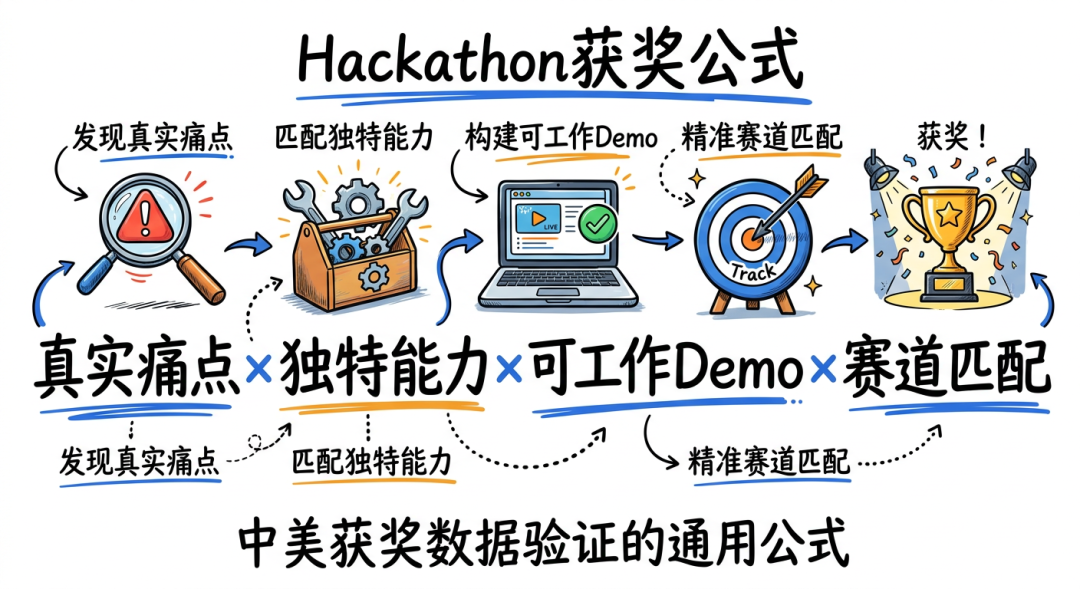
Combining China-US winner data + OpenClaw ecosystem characteristics, the following strategy emerges:
Winning Formula (OpenClaw version)
Winning = Real pain point x OpenClaw unique capability x Working demo x Track alignment
High Winning Rate Directions (combining China-US characteristics)
Direction A: Agent Security Guardian (wins in both China and US)
What to build: Build Skill security scanner/Agent behavior monitoring/permission protection system
Why it wins: China's six dos and don'ts + MIIT warning = policy demand; BNB 4/10 winners = market validation
OpenClaw capability: Skill system + multi-Agent monitoring + automation
Examples: ClawShield (Circle winner), ShieldBot (BNB #3)
Direction B: AI + Hardware (China track bonus king)
What to build: OpenClaw controls experimental equipment/robots/smart home
Why it wins: Haidian competition specifically encourages hardware integration (extra points); Shenzhen meetup 1200+ registrations
OpenClaw capability: System control + voice interaction + multi-device coordination + Telegram integration
Examples: "Iron Lobster" (experimental equipment), Watcher Robot (desktop robot)
Direction C: Productivity Automation Tools (Haidian "Productivity Lobster" track)
What to build: Automate self-media operations/digital employees/project management/CRM
Why it wins: Haidian competition judging criteria = "actual value"; Longgang "Lobster Ten Points" specifically supports this
OpenClaw capability: Full-platform message integration + Cron Job + browser automation + memory system
Applications: One-person company operating system, automated customer service, multi-platform content distribution
Direction D: Academic/Research Assistant (Haidian "Academic Lobster" track)
What to build: Literature library management/automatic experimental progress reports/data analysis
Why it wins: Haidian track explicit requirement
OpenClaw capability: Browser automation + file read/write + memory system + automated workflows
Direction E: Life Service Assistant (Haidian "Life Lobster" track)
What to build: Schedule management/travel planning/health tracking/companion chat
Why it wins: Haidian track explicit requirement
OpenClaw capability: Full-platform message integration + Cron Job + memory system
07 If You Want to Compete: Five High Winning Rate Directions
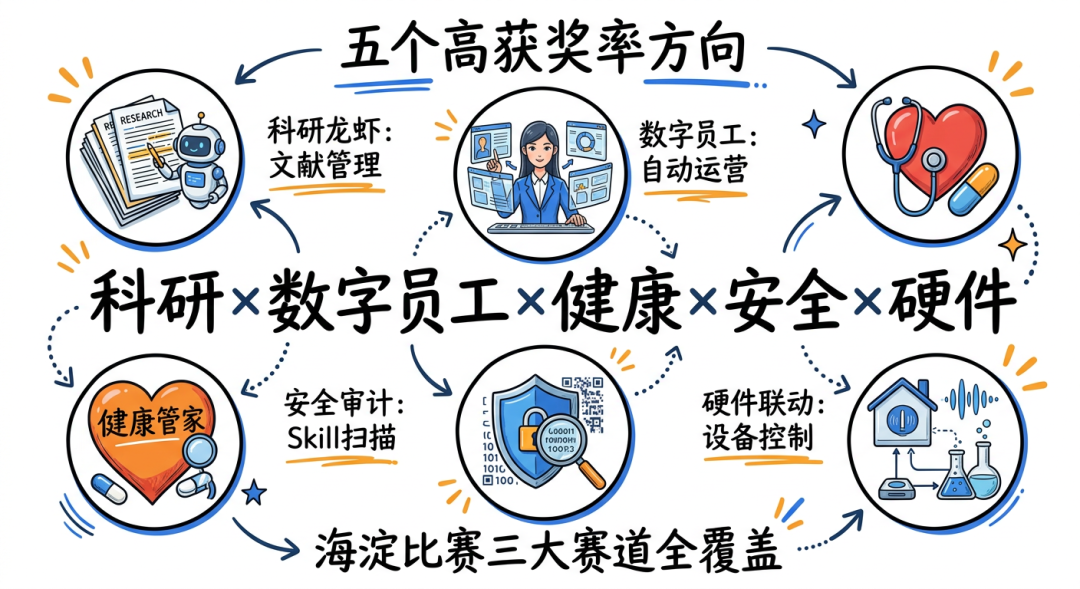
Competition Rules Review
Three Main Tracks (unified judging criteria: actual value created within each track):
Academic Lobster: Scenarios related to "understanding something" (literature management, experimental reports, research topics)
Productivity Lobster: Scenarios related to "getting things done" (self-media operations, digital employees, work automation)
Life Lobster: Scenarios related to "living well" (schedule management, travel planning, companion chat)
Judging core: Not competing on showmanship and complexity, only looking at whose "shrimp" can truly solve problems, help others, create real results.
Extra points: Innovative forms that connect to robots, smart dolls, smart home and other hardware devices.
Six Dos and Don'ts Core Requirements
Do: Use official latest version Don't: Don't use third-party mirrors/old versions
Do: Strictly control internet exposure Don't: Don't expose to public network
Do: Principle of least privilege Don't: Don't use admin privileges
Do: Be cautious using skill marketplace Don't: Don't use suspicious skill packages
Do: Guard against social engineering attacks Don't: Don't browse unknown websites/links
Do: Establish long-term protection Don't: Don't disable log auditing
Recommended Competition Directions for Haidian (ranked by winning probability)
Recommendation 1: "Research Lobster" — Academic Literature + Fully Automated Experimental Management (Academic Track)
Product: Takes over research group literature library + daily automatic experimental progress reports + intelligent literature recommendations
Why it wins:
Perfectly matches "Academic Lobster" track description ("someone used it to take over the entire research group's literature library")
Solves real research pain points (literature explosion, tedious progress tracking)
Can demonstrate complete workflow live
OpenClaw capability: Browser automation (crawl literature) + memory system (learn research direction) + Cron Job (daily reports) + Telegram/WeChat notifications
Technical difficulty: Medium
Demo scenario: "Give the shrimp a research topic, it automatically searches latest papers, generates reviews, pushes progress daily"
Recommendation 2: "Digital Employee" — One-Person Company Fully Automated Operations (Productivity Track)
Product: OpenClaw-driven fully automated self-media operations system (content generation → multi-platform distribution → data analysis → strategy adjustment)
Why it wins:
Perfectly matches "Productivity Lobster" track description ("some shrimp are fully automating self-media account operations")
Demonstrates "digital employee" concept, highly practical
OpenClaw capability: Browser automation + full platform integration + Cron Job + memory system + Skill system
Technical difficulty: Medium-high
Demo scenario: "Show from 0 to 1 how shrimp automatically writes articles, adds images, publishes to 3 platforms, analyzes reading data"
Recommendation 3: "Health Manager Lobster" — Personal Health + Schedule + Psychological Companionship (Life Track)
Product: Daily health reminders + medication management + exercise tracking + psychological companion chat + travel planning
Why it wins:
Matches "Life Lobster" track ("some people chat with it daily to relieve boredom, some hand over schedules for it to manage")
US winning trend validation: Healthcare is #1 track (27.5%)
Combining with hardware (smartwatch/sensors) gets extra points
OpenClaw capability: Message integration (WeChat/TG) + Cron Job (reminders) + memory system (learn habits)
Technical difficulty: Medium
Demo scenario: "Shrimp pushes health advice every morning, tracks your exercise/medication, chats with you in evening to review the day"
Recommendation 4: "Security Audit Lobster" — Skill Security Scanning + Permission Protection (Cross-track + Policy Bonus)
Product: Automatically scans ClawHub skill package security + runtime permission management + behavior audit logs
Why it wins:
Directly responds to MIIT "six dos and don'ts" policy demand
ClawShield won at Circle Hackathon validating direction
BNB Chain 4/10 winners did security
Chinese government highly focused on Agent security, policy-driven
OpenClaw capability: Skill system + file system control + log auditing + automation
Technical difficulty: Medium-high
Demo scenario: "Give shrimp a skill package, it automatically analyzes security risks and generates report"
Recommendation 5: "Hardware-Connected Lobster" — Smart Home/Experimental Equipment Control (Any Track + Hardware Bonus)
Product: OpenClaw controls smart home devices / laboratory equipment through natural language
Why it wins:
Competition specifically encourages hardware integration (extra points)
Shenzhen meetup "Iron Lobster" already validated direction
Strong technical differentiation (most participants do pure software)
OpenClaw capability: System control + Shell commands + device API integration + voice interaction
Technical difficulty: High (requires hardware preparation)
Demo scenario: "Tell shrimp 'start experiment', it automatically controls heater, oscillator, records data, sends email report"