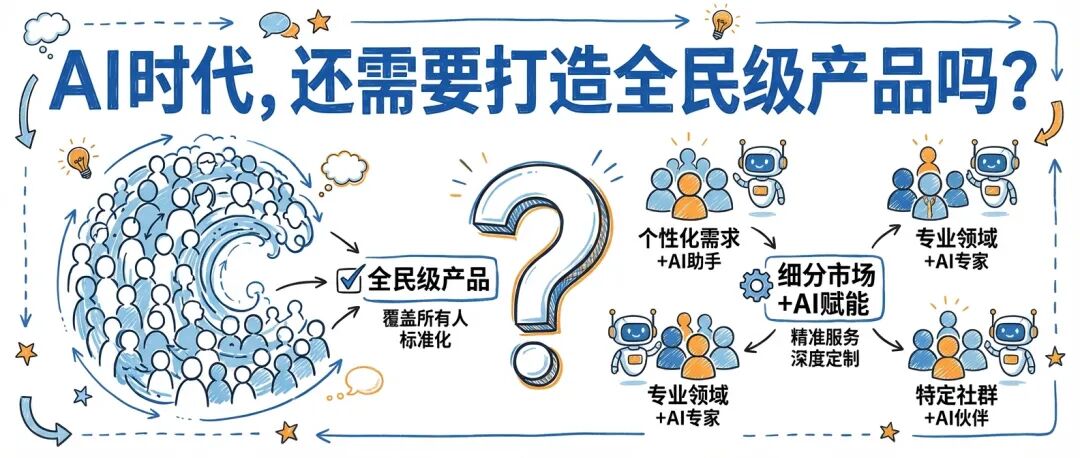
After finishing my last piece on post-resignation reflections yesterday (Post-Resignation Reflections <3/3>: Finding Hope in Darkness—Where Does Hope Lie), while still riding that high, I suddenly realized something: what I'm doing now and what's about to happen feels somewhat misaligned. As we survive, live, and work in society going forward, will we still need to operate like we do now—making friends only on QQ and WeChat, paying exclusively through WeChat and Alipay, navigating solely with Baidu and Gaode? Because the paradigm has shifted, the cost of apps has dropped, and as the next generation gradually enters society (in the next 5-10 years), will we still be stuck with just those few options for food delivery, ride-hailing, payments, short videos, shopping... forever?
Think about it: we used to "open an app to get things done," but now it's becoming "say something, and it gets done." So here's the question: In the AI era, is it still worth building the next ubiquitous super app?
The Douyin phone may have been a flash in the pan in the market, but I believe the outcome isn't its final chapter—it's its beginning, because OpenClaw has already been validating this on both PC and mobile.
So do we still need ubiquitous products in the future?
01 How Did Mobile Internet's Ubiquitous Products Come to Be?
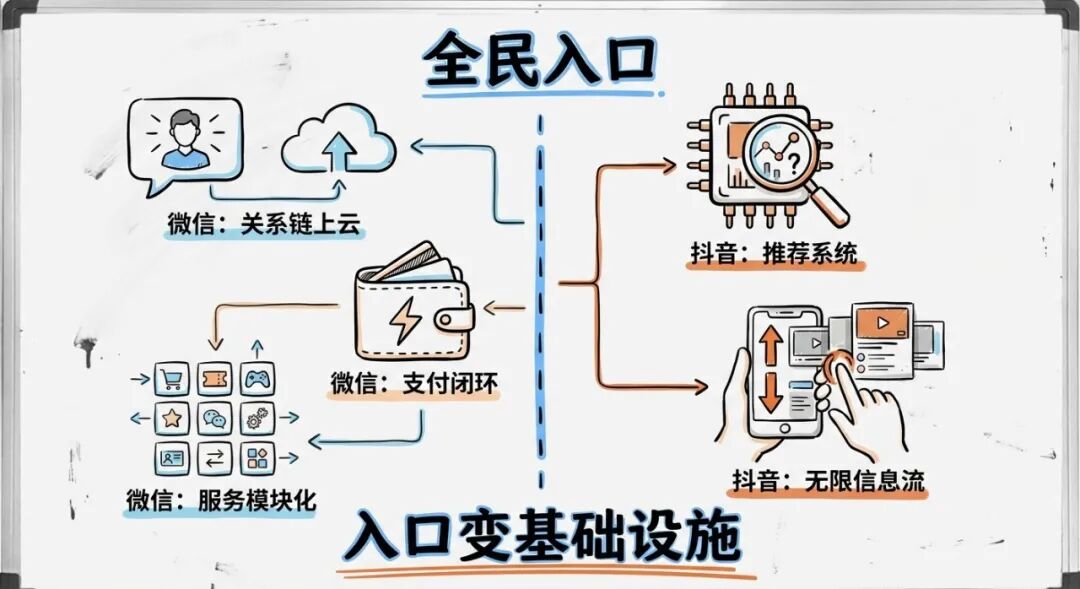
If you think of the past decade's internet landscape as a pot of soup, WeChat, Douyin, Xiaohongshu, Taobao, Meituan, and Didi—these "ubiquitous products"—are those few bones that have stewed to perfection: not because they have many features, but because they've turned "entry points" into infrastructure.
Why did WeChat become infrastructure?
WeChat's killer move wasn't chat—it was digitizing "relationships," digitizing "money," and modularizing "services."
- First, it used contacts + group chats to migrate relationship chains online. Once social migration was complete, leaving became nearly impossible.
- Then it used payments to close the transaction loop—once you got used to receiving money, transferring funds, and sending red envelopes on WeChat, it evolved from a "social tool" into a "life pipeline."
- Finally, it stuffed countless services into Mini Programs: booking appointments, ordering food, hailing rides, checking deliveries, government services... You don't need to download a bunch of apps; "you can do it all within WeChat."
WeChat integrates services into a super ecosystem with messaging + payments + Mini Programs, reaching 1.3 billion monthly active users.
Source: https://brandgenetics.com/human-thinking/introduction-to-chinas-super-apps/
Why does Douyin consume everyone's time?
Honestly, Douyin's core isn't short videos—it's the "recommendation system + infinite feed" time-harvesting machine. It turned "finding content" into "content finding you," putting people into passive consumption mode: scroll one, scroll another, scroll another.
Douyin also seamlessly integrated e-commerce, live streaming, and local services: you came for entertainment, but after being entertained you place an order, after ordering you group-buy, after group-buying you watch a livestream.
Douyin has around 750 million DAU/900 million MAU, with users averaging over 2 hours of daily usage.
Source: https://www.thatsmandarin.com/chinese-apps/chinese-social-media/
Why did Xiaohongshu become young people's search engine?
Not through "more comprehensive information," but through "sounding more like real people talking." Search "foundation recommendation" on Baidu and you get a pile of ads; search "foundation that won't melt off oily-combo skin in summer" on Xiaohongshu and you get posts filled with skin types, budgets, and scenarios from real people.
Xiaohongshu structured "experience" into searchable content while building trust through community atmosphere (planting/pulling weeds)—that's why it could steal the "lifestyle search" entry point.
Xiaohongshu has about 300 million MAU, using UGC + community trust + consumption decision scenarios to gradually assume the "lifestyle search" role.
Source: https://www.hicom-asia.com/chinese-social-media-platforms/
These three actually represent the most typical "entry points" of the mobile internet era:
- WeChat: relationship entry point
- Douyin: attention entry point
- Xiaohongshu: decision-making entry point
02 Common Characteristics of These Products: Network Effects, Habit Monopoly, Entry Point Occupation
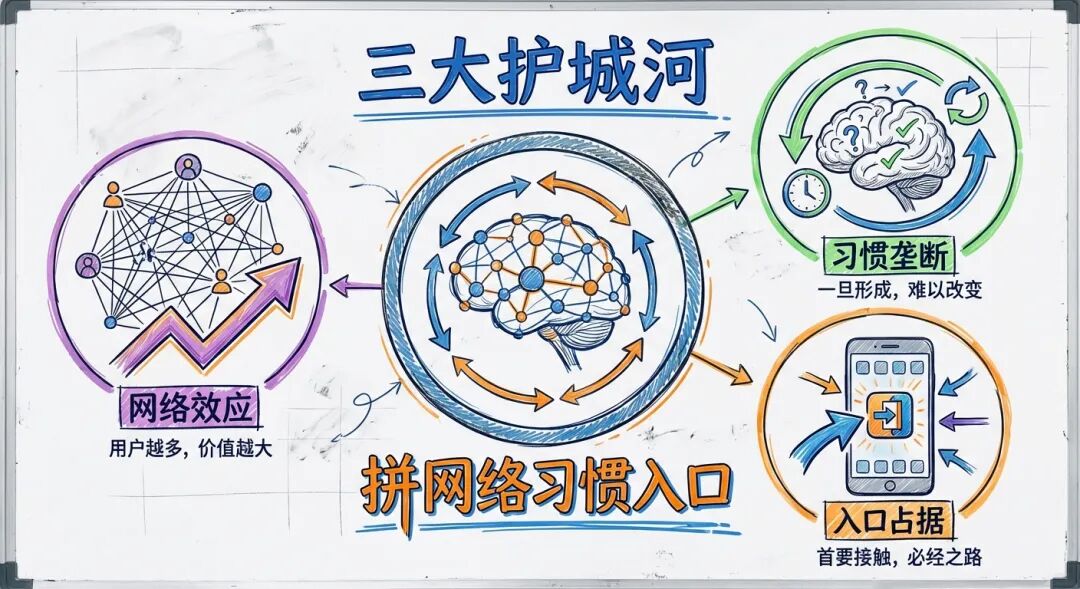
You'll find that ubiquitous products ultimately compete not on "features," but on three things:
1) Network Effects: More people = stronger, stronger = more people
WeChat has social network effects; Douyin has content network effects (more creators → more content, more users → more precise distribution); Taobao has transaction network effects (more merchants → more choices → more users → merchants more willing to join).
What's terrifying about this: no matter how well you do, if your scale falls short, it's extremely hard to gain traction.
2) Habit Monopoly: Not that you can't leave it, but you're too lazy to switch
Why is it so hard to "switch" food delivery services? Because your favorites, addresses, coupons, membership, order history are all there.
Douyin's even more ruthless: it trains your brain's dopamine circuits. You're not using the app; it's using you.
3) Entry Point Occupation: It decides where you start your day
The entry point in the mobile internet era is the "desktop icon." Whoever occupies the desktop decides the user's first jump.
That's why super apps love building "product suites"—not out of greed, but strategy: capturing every starting point of your needs.
Super apps integrate payments, messaging, content, services, and Mini Program ecosystems, reducing app-switching friction and forming strong network-effect moats.
Source: https://digitalcreative.cn/blog/china-mini-programs-ecosystems-wechat-alipay-douyin
03 What AI Is Changing: When Users Say "Book Me a Flight" Instead of "Open Ctrip"
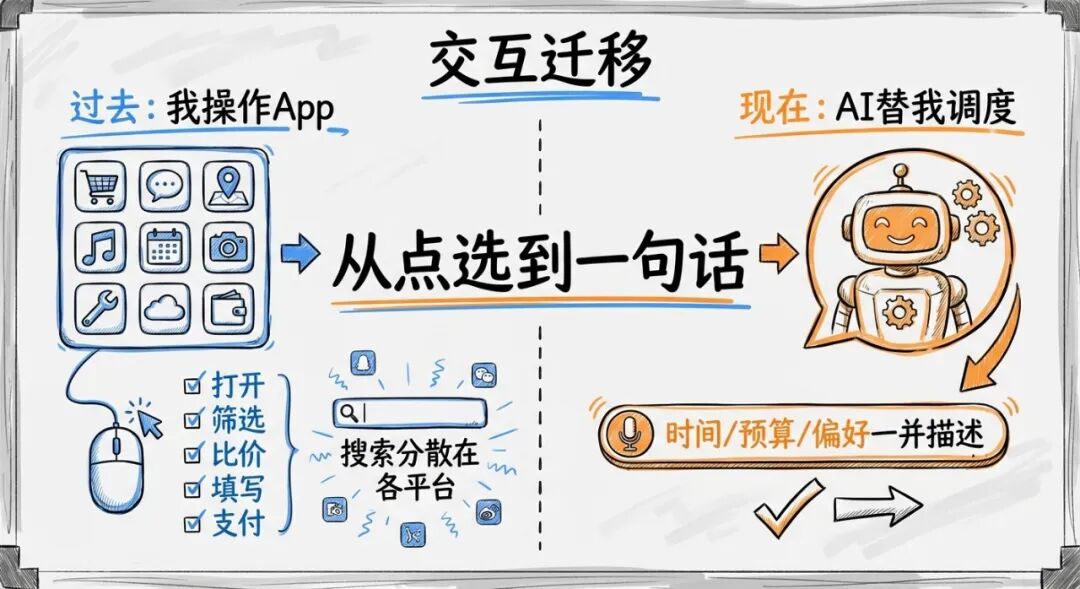
The biggest change AI brings, I believe, isn't "smarter"—it's the migration of interaction methods: from "tap tap tap" to "say something."
Before, booking a flight meant: open Ctrip/Fliggy → pick dates → filter flights → compare prices → fill in info → pay.
Now users' psychological expectations are becoming:
"I'm going to Shanghai next Wednesday through Friday, preferably early departure and late return, budget under 2,000 yuan, list the best options and pair them with hotels too."
Notice the subject changed: it used to be "I operate the app," now it's "AI coordinates tools for me."
Even worse, recommendations and search are migrating too:
- Used to "want to buy something" → search on Taobao
- "Want to go somewhere" → search on Xiaohongshu
- "Want to know something" → search on Baidu
Now many people's first reaction is: ask AI. Because AI can process "information" into "answers" and turn answers into "actions."
The trend is AI as a universal interface reducing app-switching friction and driving conversational commerce with platform integration (2025-2027).
Source: https://businessengineer.ai/p/ai-and-americas-super-app-moment
And this isn't imagination. Enterprises are already migrating customer service and business processing to multimodal assistants, directly reducing labor and processing time.
A European utility company deployed multimodal AI assistants to millions of users, significantly reducing processing time and improving satisfaction.
Source: https://www.mckinsey.com/capabilities/tech-and-ai/our-insights/superagency-in-the-workplace-empowering-people-to-unlock-ais-full-potential-at-work
So a subtle shift is happening with entry points:
Desktop icon importance is declining; "default dialogue box" importance is rising.
When your phone, OS, browser, or even WeChat/Douyin itself has a built-in AI entry point, users' first jump might not be to a specific app, but "let me ask AI first."
04 But Ubiquitous Products Won't Simply Vanish: AI Can't Replace Social Graphs, Content Ecosystems, or Supply Chains
Many people see AI and conclude: "Apps are dead."
Honestly, I don't buy it.
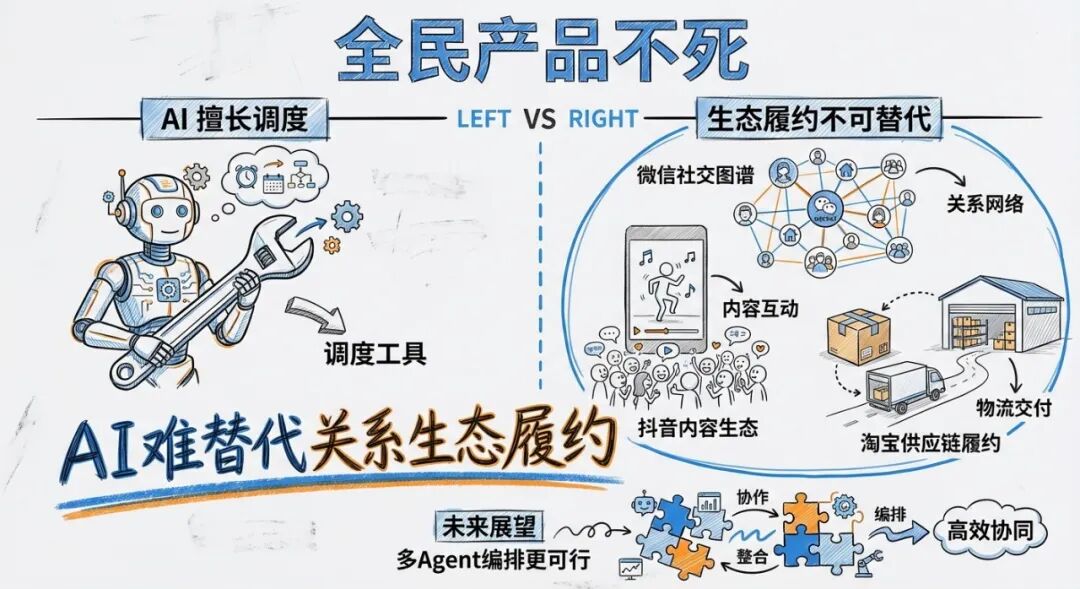
The reason is simple: AI excels at "coordinating information and tools," but can't conjure "relationships, ecosystems, and fulfillment capabilities" out of thin air.
- WeChat's social graph: Your contacts, groups, relationship chains, trust mechanisms (who's whose friend, who said what in groups)—this isn't calculated by a large model; it's "social capital" accumulated over a decade-plus.
- Douyin's content ecosystem: Creators, MCNs, trending mechanisms, review systems, monetization systems... AI can generate content, but an "ecosystem" is built from human behavior and shared rules.
- Taobao's supply chain and fulfillment: Merchant systems, warehousing/logistics, after-sales, reviews, dispute resolution, risk control... Having AI "recommend a piece of clothing" is easy; having AI "reliably deliver that clothing to you and handle returns/exchanges" isn't so simple.
More realistically: AI Agents currently struggle to "complete everything end-to-end in one go." The more complex the task, the more it needs specialized tools and modules coordinating, not one omnipotent brain forcing it through.
General monolithic Agents face constraints like context windows, specialized depth, and single-point failures; modular/multi-agent orchestration is more viable.
Source: https://www.gocodeo.com/post/decoding-architecture-patterns-in-ai-agent-frameworks-modular-vs-monolithic
This also explains why "super apps won't be killed in 2025-2026." The more likely path is: Super apps become AI-enabled; AI platforms become super apps.
The more consistent judgment currently is: AI won't quickly kill super apps but is accelerating the emergence of AI-driven super apps and integrated ecosystems.
Source: https://financewire.com/2026/02/09/ai-super-apps-emerge-as-the-next-phase-of-competition-in-the-u-s-market/
In other words:
- WeChat won't be killed by AI; it'll swallow AI whole.
- Douyin won't be killed by AI; it'll turn AI into "stronger recommendations, stronger creation, stronger transaction assistants."
- Taobao won't be killed by AI; it'll turn AI into "shopping guides, customer service, operations, supply chain optimization."
05 The New Ubiquitous in the AI Era Might Not Be an App, But a "Capability Layer/Protocol Layer"
So will "the next ubiquitous product" still emerge? I think yes, but the form will likely change.
Mobile internet era's ubiquitous products looked like this: One super app = one huge city.
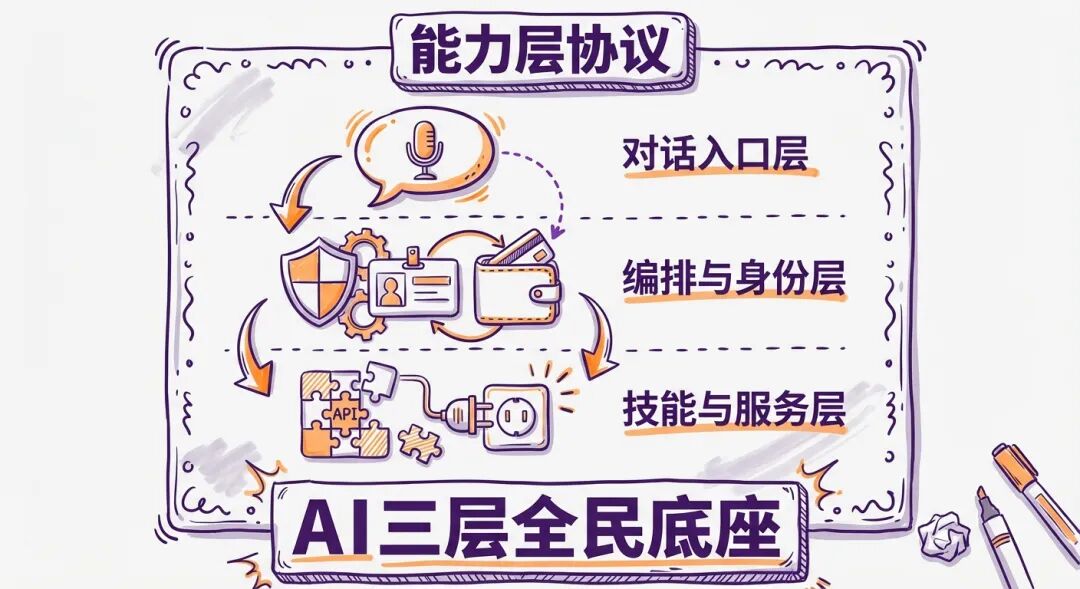
The AI era will more likely look like: One capability/protocol layer = one set of universal roads and utilities.
You can think of it as three layers:
First layer: Dialogue entry layer (where you start speaking)
Could be at the system level (phone OS), in browsers, or within some super app, but it'll increasingly resemble a "default entry point."
Second layer: Orchestration and identity layer (who coordinates, who's responsible)
For AI to do things for you, it must solve:
- Who are you (identity/permissions)
- Can you pay (wallet/payment)
- What are you allowing it to do (authorization/risk control)
- What tools did it invoke (traceable/auditable)
What truly has a chance to become "ubiquitous" in the future, I think, is this layer: a trusted AI orchestration layer, like "autonomous driving with a handbrake."
Third layer: Skills and services layer (what it actually invokes to complete tasks)
This will be highly modular, like Mini Programs but at finer granularity and more API-ized: booking flights is a skill, expense reporting is a skill, checking health records is a skill, contract review is also a skill.
One 2026 super app trend is using modular Mini Programs/micro-frontends and APIs to carry extensions, alleviating feature bloat and improving cross-conversion.
Source: https://innowise.com/blog/mobile-app-development-trends/
So you'll see a somewhat counterintuitive picture:
"Ubiquitous" might not be an icon, might not be an app.
It's more like a "default available capability layer" connecting countless services, making users feel: I just need to speak.
06 Lessons for Entrepreneurs: Don't Build the Next WeChat—Build an Irreplaceable Link in AI's Call Chain
If you're an entrepreneur, especially a solo founder/small team, my advice is pretty blunt:
Stop fantasizing about "I'll also build a ubiquitous app."
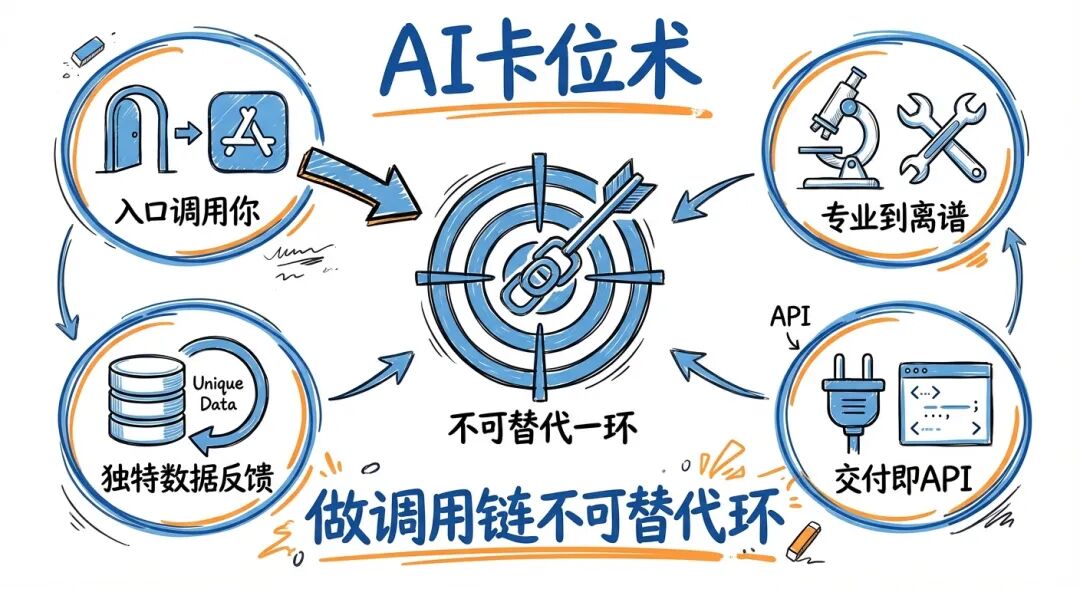
What you should do is: Occupy an irreplaceable position in AI's call chain.
Why? Because ubiquitous products' three moats—network effects, habit monopoly, entry point occupation—are too unfriendly to small teams. You don't have the budget to fight for entry points, resources to build ecosystems, or time to endure a decade of network effects.
But the AI era gives small teams a new opportunity: You don't need to own the user entry point; you just need to be invoked by the entry point.
You can ask yourself four more realistic questions:
1) Can I provide a skill that's "absurdly specialized"?
General large models are strong, but in vertical domains they often "seem to know but aren't actually accountable."
If you can do something to perfection—like cross-border tax refunds, corporate expense compliance, medical insurance clause comparison, B2B quotations, contract clause risk control—AI will invoke you because you're more reliable.
2) Can I possess unique data or closed-loop feedback?
Large models don't lack knowledge; they lack "latest, real, verifiable" data streams and outcome feedback.
If you can master first-hand data (even if narrow), you'll evolve from "tool" to "foundational component."
3) Can I turn delivery into an API instead of a pretty interface?
AI's favorite products to invoke aren't "apps requiring many taps" but "stable interfaces."
Make yourself into an invocable service, and you enter the division-of-labor system instead of competing with giants for desktop space.
4) Can I provide trust: compliance, risk control, responsibility boundaries?
AI acting on behalf of people fears mistakes most. The more it involves money, contracts, healthcare, privacy, the more it needs "accountable" professional systems.
Many entrepreneurial opportunities aren't in "smarter" but in "more responsible."
The trend favors orchestrated workflows and on-demand skill injection rather than monolithic all-capable Agents doing everything.
Source: https://cobusgreyling.substack.com/p/three-ai-agent-architectures-have
Finally, here's a very "grounded" judgment criterion:
If your product can't survive without "entry point traffic," you're probably still operating in mobile internet era narratives.
Stronger products in the AI era often are: can survive without traffic because they're "part of the foundational chain."
You don't have to build the next WeChat.
You can build "that link WeChat/system AI/some Agent must invoke every time it completes a certain task."
This doesn't sound as sexy, but it's more real, more suited to small teams, and more likely to make money.
Conclusion: The Dream of Ubiquity Remains, But the Path Has Changed
I believe the AI era won't cancel "ubiquitous products"—it's just migrating ubiquity from "a super app icon" to "the existence of a default capability layer." Entry points will become more like air: you might not see them, but you can't live without them daily.
For giants, this is an entry point defense battle: install AI into their ecosystems and remain the default option.
For entrepreneurs, this is a division-of-labor reorganization: don't fight for entry points; become the hardest screw in the chain.
You ask me if we still need to build ubiquitous products?
Yes, but more importantly: You need to figure out whether you're building a "city" or paving a "road."
Source List
- https://businessengineer.ai/p/ai-and-americas-super-app-moment
- https://financewire.com/2026/02/09/ai-super-apps-emerge-as-the-next-phase-of-competition-in-the-u-s-market/
- https://digitalcreative.cn/blog/china-mini-programs-ecosystems-wechat-alipay-douyin
- https://brandgenetics.com/human-thinking/introduction-to-chinas-super-apps/
- https://www.thatsmandarin.com/chinese-apps/chinese-social-media/
- https://www.hicom-asia.com/chinese-social-media-platforms/
- https://innowise.com/blog/mobile-app-development-trends/
- https://www.mckinsey.com/capabilities/tech-and-ai/our-insights/superagency-in-the-workplace-empowering-people-to-unlock-ais-full-potential-at-work
- https://www.gocodeo.com/post/decoding-architecture-patterns-in-ai-agent-frameworks-modular-vs-monolithic
- https://cobusgreyling.substack.com/p/three-ai-agent-architectures-have
Further Reading
- https://businessengineer.ai/p/ai-and-americas-super-app-moment
- https://financewire.com/2026/02/09/ai-super-apps-emerge-as-the-next-phase-of-competition-in-the-u-s-market/
- https://innowise.com/blog/mobile-app-development-trends/
- https://www.mckinsey.com/capabilities/tech-and-ai/our-insights/superagency-in-the-workplace-empowering-people-to-unlock-ais-full-potential-at-work
- https://builtin.com/articles/top-tech-trends-2026
- https://foresightmobile.com/blog/mobile-app-economy-2026-monetisation-ai-foldables
- https://digitalcreative.cn/blog/china-mini-programs-ecosystems-wechat-alipay-douyin
- https://brandgenetics.com/human-thinking/introduction-to-chinas-super-apps/
- https://www.thatsmandarin.com/chinese-apps/chinese-social-media/
- https://www.hicom-asia.com/chinese-social-media-platforms/
If you're also interested in AI, Vibe Coding, and "solo companies,"
add me on WeChat—let's exchange ideas and grow together!