I. Background
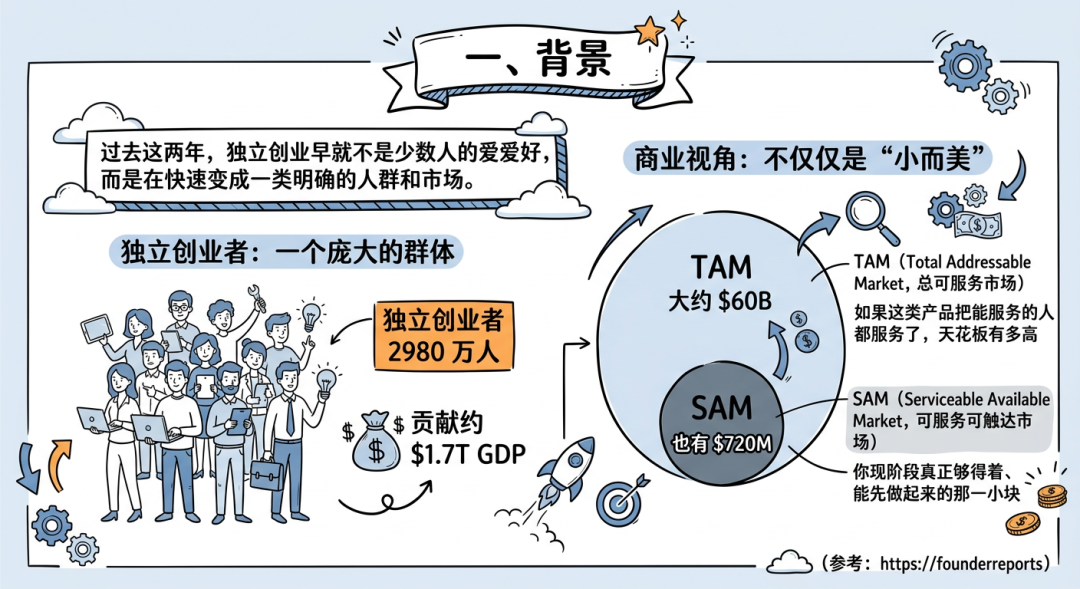
Starting from mid-2025, the concept of the one-person company began taking root abroad. Now, cities and regions everywhere are rolling out various subsidies and support policies. Solo entrepreneurship is no longer a niche hobby—it's rapidly becoming a distinct demographic and market segment.
By the metrics I used in this round of research, solo entrepreneurs already represent a group of 29.8 million people, contributing approximately $1.7T to GDP in the U.S. market alone (since data sources are primarily from international platforms).
From a business perspective, this isn't some "small and beautiful" corner market: TAM is roughly $60B, with SAM at $720M. Here, TAM (Total Addressable Market) can be understood as "if this type of product served everyone it could possibly serve, what's the ceiling?" SAM (Serviceable Available Market) is more like "the slice you can realistically reach and build up right now."
(Sources: https://founderreports.com/solopreneur-statistics/, https://theweeklymomentum1.substack.com/p/the-solopreneur-rise-one-person-1b)
How did I end up here myself? Simple: I quit my job.
As of today, there are 4 days left until it's been exactly 3 months since I left. In these full 3 months, my biggest realization isn't that writing code is hard. Only after quitting did I truly discover that AI is dismantling the barriers to "entrepreneurship" piece by piece. Code turns out to be the most straightforward part. What's really hard is:
Every decision has no one to discuss with.
Should I build this feature or not?
How should I price it?
Is this direction actually right, or am I just fooling myself?
Working solo for long enough is like driving alone at night: the car keeps moving forward, but there's no passenger to help watch the road or remind you if you've already veered off course.
So I stopped relying on gut feeling.
I built a self-hosted V7 Pipeline (version 7 information processing pipeline—not some mysterious black box, essentially just an automated workflow of "scrape → clean → categorize → score").
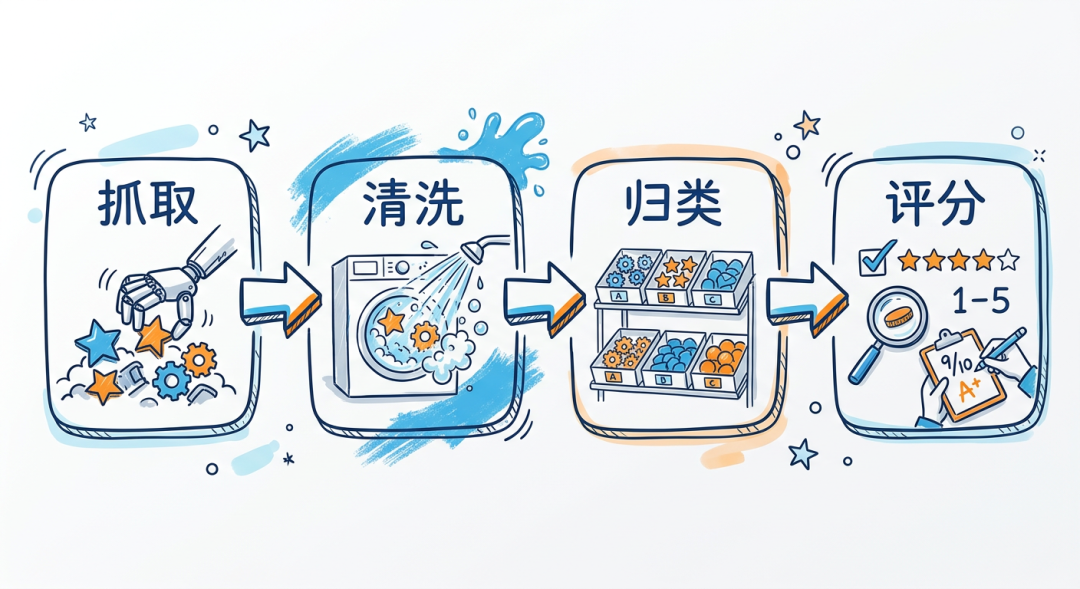
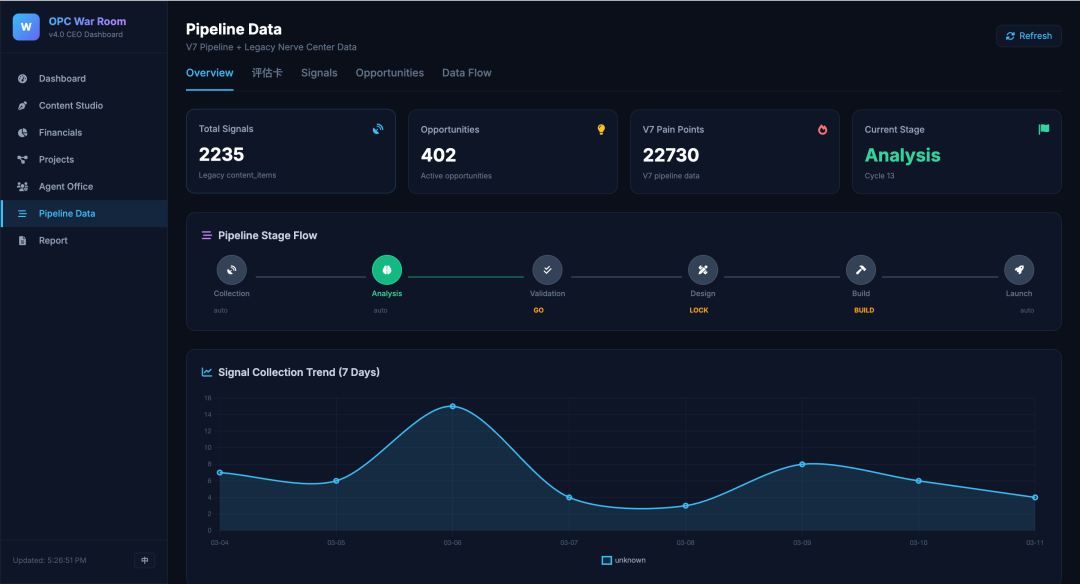
I created an AI-driven (AI-assisted initial screening and organization, like hiring a research assistant who never clocks out) product discovery system. It scraped 20,000+ authentic expressions from solo entrepreneurs across four platforms—IndieHackers, Reddit, Hacker News, and X/Twitter—deduplicated and cleaned the data, filtered down to 212 high-quality pain points, then used clustering (grouping similar problems into the same bucket) to organize these pain points into 10 groups, with 7 of them converging toward the same product direction. According to my scoring model, the composite score is 83/100—a five-star GO (worth doing, and worth doing soon), far above the 65-point threshold.
This is why I want to seriously talk to you all today: maybe what solo entrepreneurs lack most when working alone really isn't more tools...
II. Pain Points
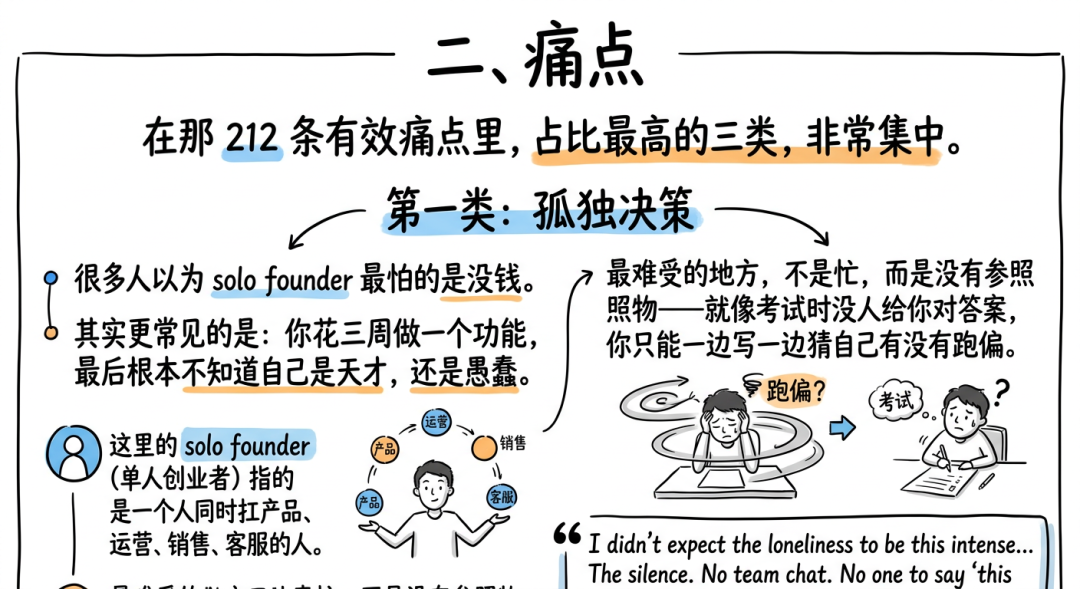
Among those 212 valid pain points, the top three categories are highly concentrated.
First: Isolated Decision-Making
Many think solo founders fear running out of money most. Actually, what's more common is this: you spend three weeks building a feature and have absolutely no idea if you're brilliant or foolish. The term solo founder (a person simultaneously handling product, operations, sales, and customer service) captures this perfectly. The hardest part isn't being busy—it's having no reference point. It's like taking a test with no one to check your answers against; you can only write while guessing if you've gone off track.
"I didn't expect the loneliness to be this intense… The silence. No team chat. No one to say 'this is a good idea' or 'this is stupid.'"
— Source: Reddit / r/Solopreneur
https://www.reddit.com/r/Solopreneur/comments/1re644x/solopreneurship_is_a_lonely_path_does_it_have_to/
"Working solo means your wins feel smaller and your setbacks feel enormous because there's no one to provide perspective."
— Source: Indie Hackers
https://www.indiehackers.com/post/why-indie-founders-fail-the-uncomfortable-truths-beyond-build-in-public-b51fd6509b
Second: Zero Follow-Through
Goals set on Monday are forgotten by Wednesday. It's not about lack of effort—it's about having no external rhythm, no one genuinely asking: did you actually make progress this week? Many solo entrepreneurs don't lack plans; they lack someone who consistently knocks on their door. It's like going to the gym—you know all the moves, but without someone waiting for you or tracking whether you showed up, the easiest thing to happen is "I'll do it tomorrow."
@mdgale: "I'm looking for an accountability partner! I'd like to have a <15 minute call, M-F @ 9am PST with another indie hacker to set the tone for the work ahead."
— View original
"I'm a solopreneur, and sometimes it's hard to stay motivated or stick to one task. I'm thinking of trying an accountability partnership…"
— Source: Reddit / r/Entrepreneur
https://www.reddit.com/r/Entrepreneur/comments/1qxlut4/looking_for_accountability_partner/
Third: Feedback Vacuum
Many people build in public (openly documenting their product-building process, showing progress as they go—like renovating while letting passersby watch), but reality is: you post an update, get 2 likes, 0 useful feedback. It's not that you're not sincere enough—the platform simply isn't delivering "the right people" to you. So your message is like being tossed into the ocean, making only a tiny splash.
"My biggest concern would be the audience… I'm a nobody…"
— Source: Indie Hackers
https://www.indiehackers.com/post/if-you-dont-build-in-public-you-re-wasting-your-time-0cde4c5462
"Getting testimonials as social proof is always on top of my mind."
— Source: Indie Hackers
https://www.indiehackers.com/post/hit-100k-arr-after-9-months-grinding-as-a-solo-founder-ama-584379b1f6
This isn't isolated. External surveys (questionnaire statistics) confirm it: 22% of solopreneurs (solo entrepreneurs) have no one to seek business advice from, 35% are under high stress, and 34% have seriously considered quitting.
(Sources: https://founderreports.com/solopreneur-statistics/, https://founderreports.com/entrepreneur-mental-health-statistics/)
Put plainly, tools like Notion for organization, Cursor for AI coding, and Claude as an AI assistant already exist in abundance. What people lack isn't another hammer—it's an environment that continuously helps you validate direction, push actions forward, and get feedback.
III. Current Situation
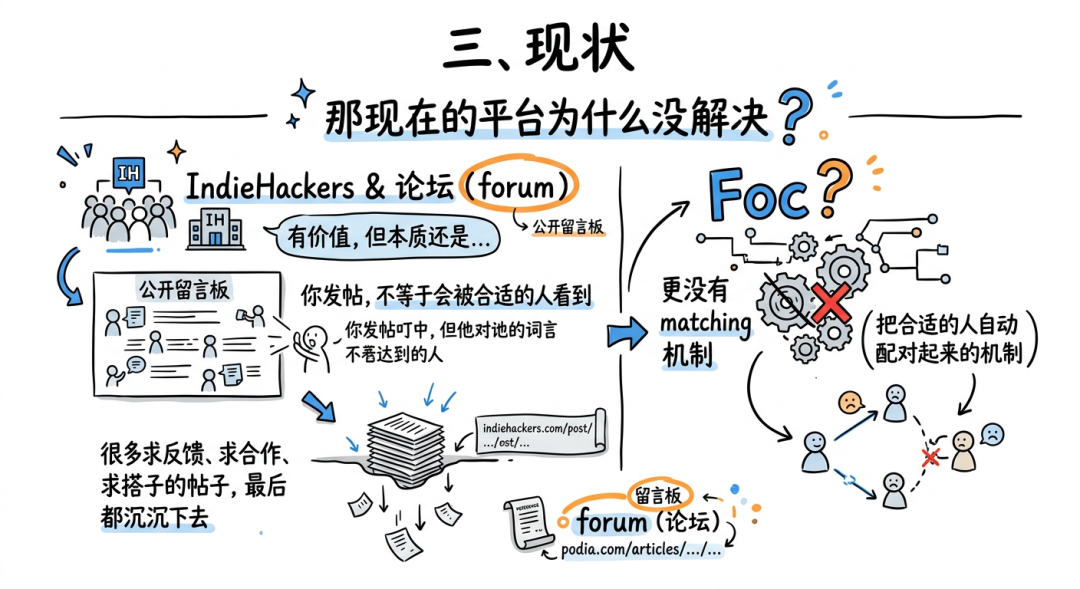
So why haven't existing platforms solved this?
IndieHackers has value, but it's essentially a forum (like a public message board). You post, but that doesn't mean the right people will see it. There's no matching mechanism (a system that automatically pairs suitable people together). Many posts seeking feedback, collaboration, or partners end up buried.
(Sources: https://www.indiehackers.com/post/if-you-dont-build-in-public-you-re-wasting-your-time-0cde4c5462, https://www.podia.com/articles/best-online-community-platforms)
Focusmate solves "sitting down to work for 50 minutes first." It's useful for focus, but doesn't address what your next step in the entrepreneurship chain should be, nor does it handle PMF, feedback, and growth. PMF (Product-Market Fit) can be simply understood as "what you're building, people actually need it continuously and are even willing to pay for it continuously." Focusmate is more like helping you get to the study room on time, but it won't tell you which course to study.
(Sources: https://whop.com/blog/online-community-platforms)
Hampton is strong but follows a high-barrier approach, with annual costs publicly discussed as reaching $15,000—99% of solo entrepreneurs can't get in from the start. It's more like a premium members-only club, not a public training ground most people starting out can casually walk into.
(Sources: https://circle.so/blog/best-community-platforms)
WIP.co is more like a check-in stream; Skool is better suited as a content creator community SaaS (a tool for content creators running courses, communities, and membership businesses), not designed for solo entrepreneurs' weekly execution (the weekly rhythm of actually pushing things forward). One lacks growth collaboration and tool support; the other isn't built around the main thread of "weekly goals, feedback, collaboration, and review."
(Sources: https://whop.com/blog/online-community-platforms, https://schoolmaker.com/blog/best-online-course-and-community-platforms)
So my final conclusion is straightforward:
There's still no platform in the market that genuinely puts "follow-through + community + growth collaboration + AI tools" together.
IV. The Solution: ADot-Community
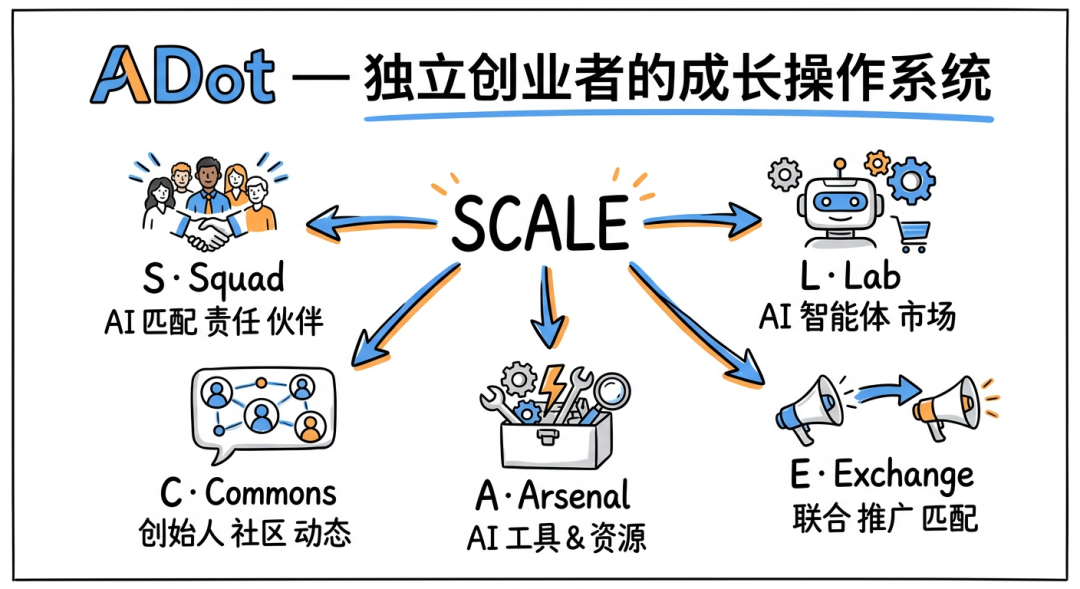
The project I'm working on now is called ADot-Community. This is also the fundamental reason why my notes reference "a little dot."
One-line positioning: The growth operating system for solo entrepreneurs.
The "operating system" here isn't Windows or macOS on your computer—it's a working method that strings together goals, feedback, collaboration, and tools. For solo entrepreneurs, it's more like "a training ground with someone running alongside you."
Because of this direction, 7 out of 10 pain point clusters converged here, ultimately distilling into 5 core functions.
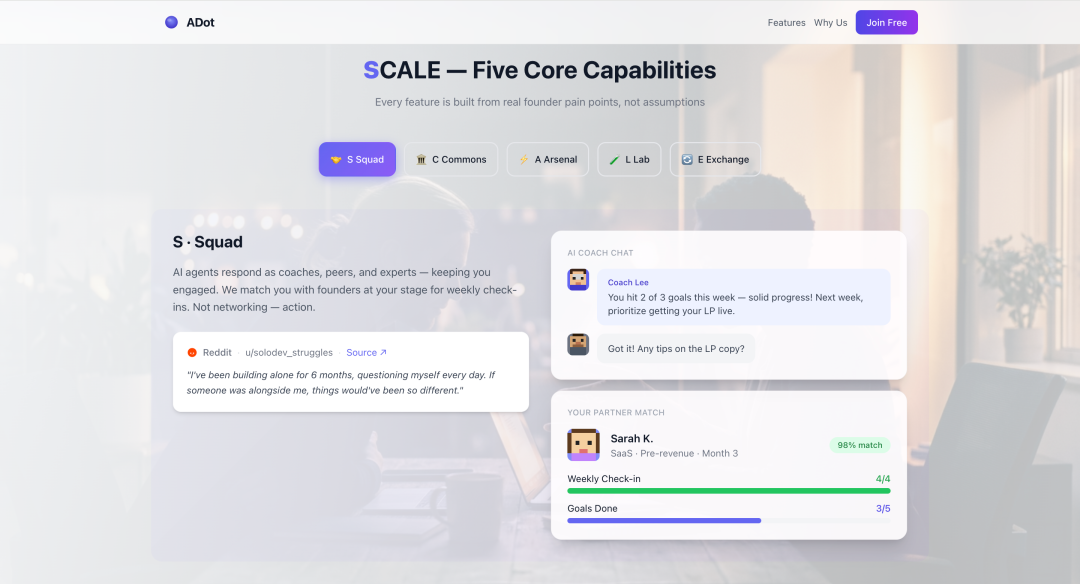
S · Squad
Use AI to match accountability buddies based on stage, time zone, and goals. Set goals Monday, do check-ins (quick progress confirmations) midweek, and review together Friday. No more relying solely on "I should be disciplined" to power through.
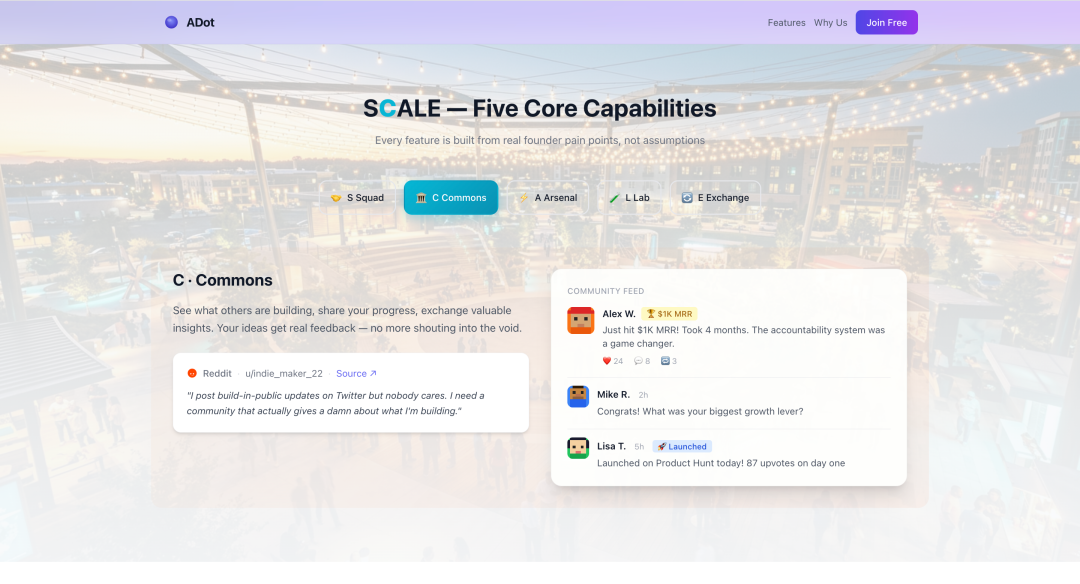
C · Commons
A community feed better suited for founders (entrepreneurs)—think of it as "a Moments/Timeline that understands the startup context better." Your milestones (key progress like launching, getting your first paying user, completing a redesign) aren't just posted—they're seen and responded to by people more likely to understand you.
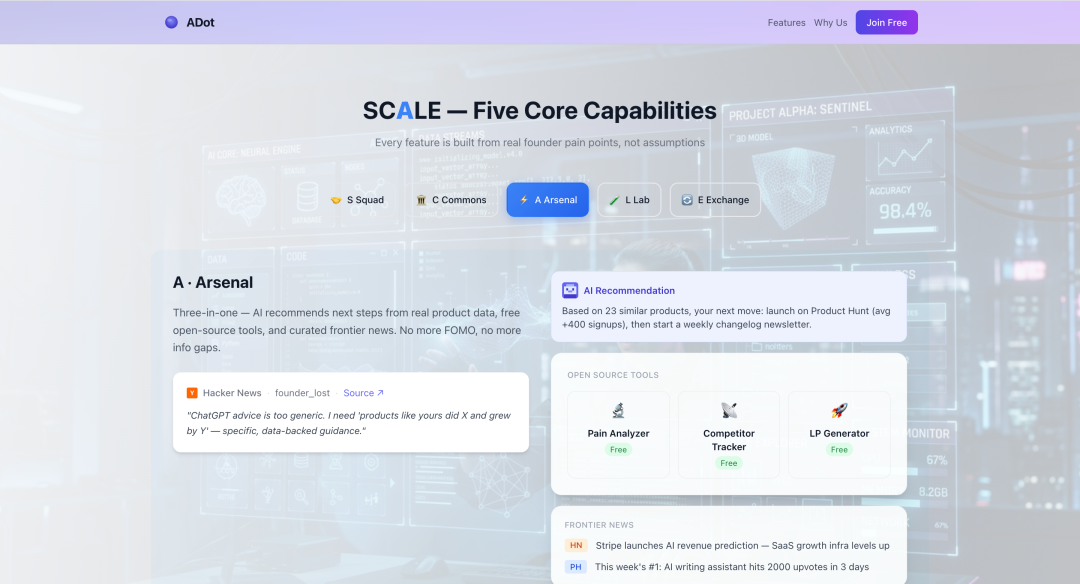
A · Arsenal
Organize AI recommendations, open-source tools (publicly shared tools you can use directly), and cutting-edge information into actionable materials. Less scrolling feeds, more effective action.
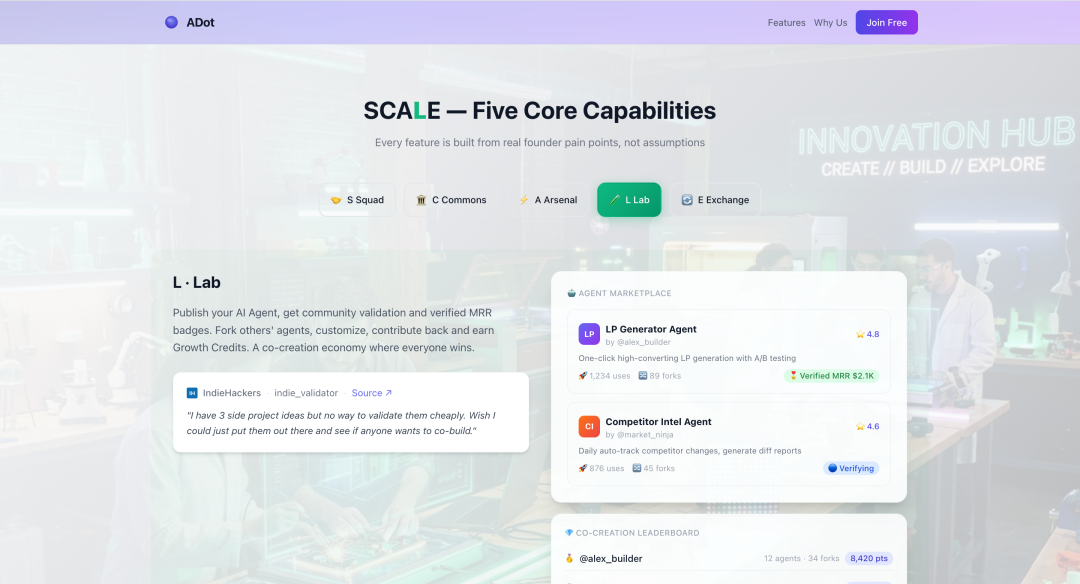
L · Lab
An AI Agent market (intelligent assistant marketplace). AI Agents (smart assistants that complete repetitive work for you) can help you collect information, organize feedback, and run validation processes. You can publish needs, validate ideas, find collaborators—no need to build workflows from scratch every time.
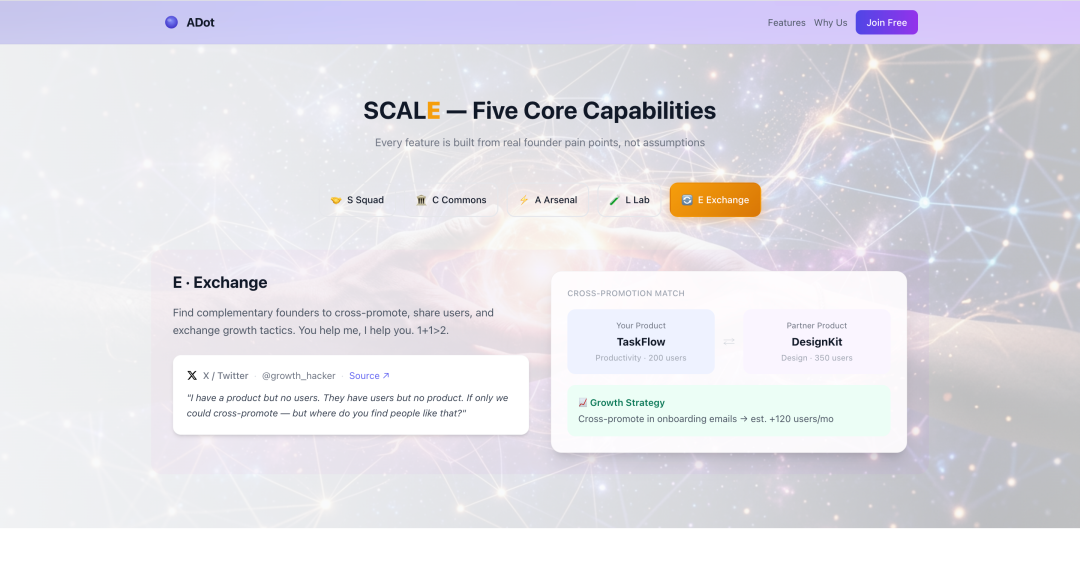
E · Exchange
Match cross-promotion and swap users. Newsletters (email subscriber readers), beta users (early testers), waitlists (queue lists), and channel slots (exposure positions) can all be exchanged more naturally. For many solo entrepreneurs, the hardest part isn't building the product—it's finding "the first batch of people who know you and are willing to try you."
If you join as a Founding Member (the earliest batch who try it out together and provide feedback), what you can expect isn't a cold community account, but: priority partner matching, early feature beta access, roadmap co-building rights, retention of future benefits, and mutual support from the first batch of real entrepreneurs.
The process is also simple:
【Register】 → 【AI Match Partner】 → 【Set Monday Goals】 →
【Friday Mutual Review】 → 【Share Milestones in Community】.
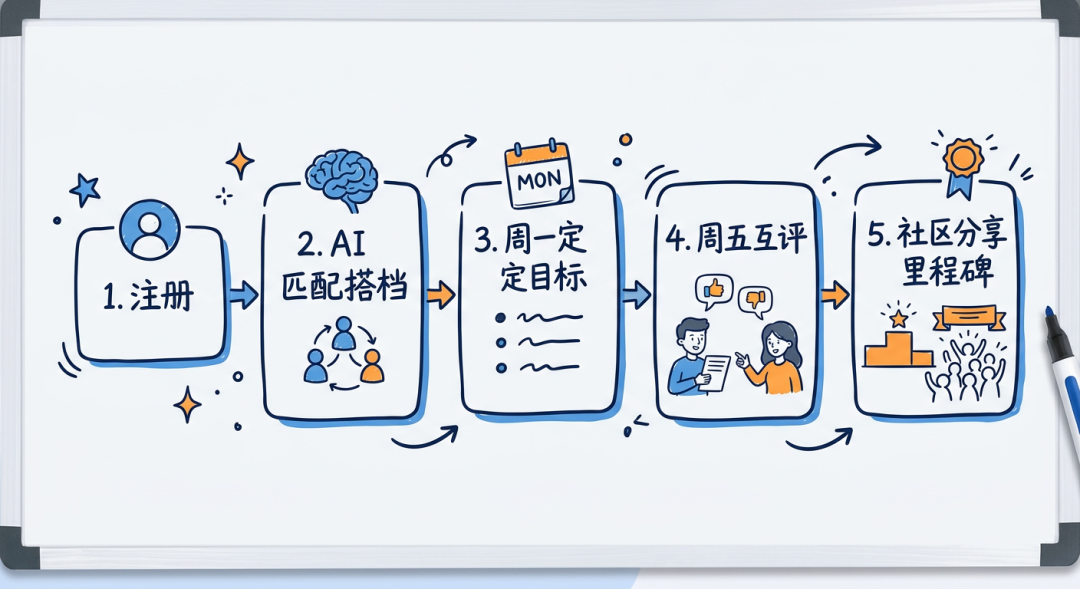
What I want to build isn't another dashboard (a backend page crammed with buttons and data). It's to make "carrying it alone" not so hard.
Real Voices on X/Twitter
@FastCompany: "Building a business alone can feel isolating. But experts say it doesn't have to be. How to break the solopreneur 'loneliness loop'. www.fastcompany.com."
— (https://x.com/FastCompany/status/1991285569955996098)
@joshschachnow1: "Maybe the biggest problem for solopreneurs: working alone. For ... - productivity and mental health as a solopreneur - adapting to AI and future trends and more. How do you get over the solo parts.."
— (https://x.com/joshschachnow1/status/1933250688294756847)
@VirtualHand: "The challenge many solopreneurs face is the belief that to run a business alone, they must work alone. Read more lttr.ai/AoC2k"
— View original
@KRBOOKTALK: "A gentle nudge for mindset shifts while working solo Sometimes the ... Yet, by focusing on mindset care and mental health strategies, entrepreneurs can rebuild resilience and thrive sustainably. ... "Entrepreneurship is a lonely"
—(https://x.com/KRBOOKTALK/status/2021566602827747499)
@mdgale: "I'm looking for an accountability partner! I'd like to have a <15 minute call, M-F @ 9am PST with another indie hacker to set the tone for the work ahead."
— View original
V. I Want to Hear Your Take
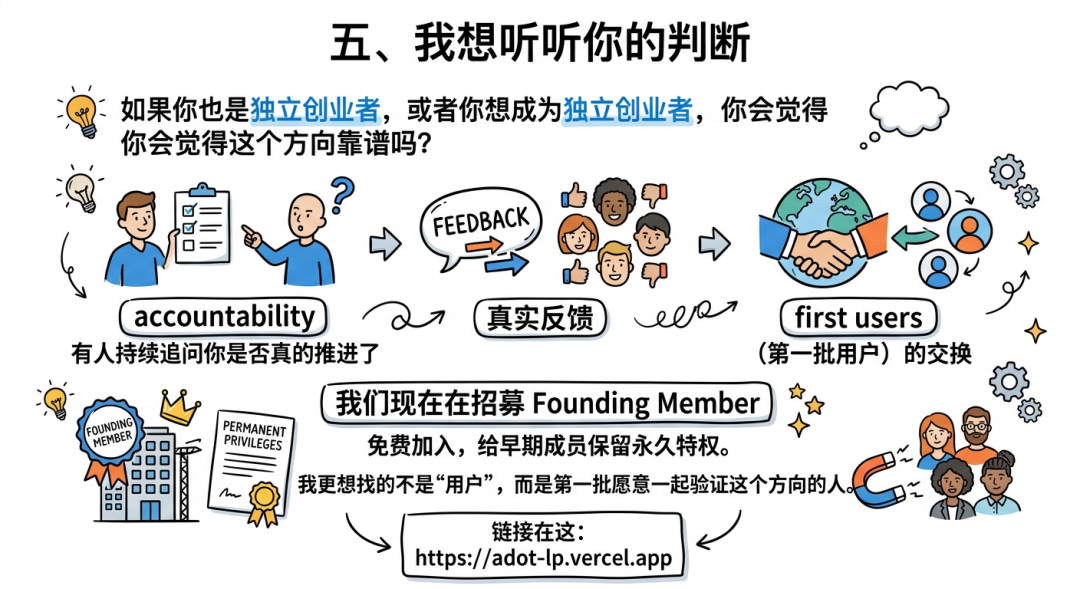
So whether you're my friend, former colleague, classmate, a solo entrepreneur yourself, or aspire to become one—do you think this direction makes sense?
What do you want most: accountability (someone continuously asking if you're actually making progress), genuine feedback, or exchange of first users?
We're currently recruiting Founding Members—join free, with permanent perks reserved for early members. What I'm looking for isn't "users," but the first batch of people willing to validate this direction together.
Of course, this is just a test and research round to see how many "paying" users there might be. The website is currently English-only; I've done the Chinese version, but still need to research the registration flow. If you understand a bit of English, the content is readable. So if you think this product is necessary, click Free Join and enter your email. If you think this direction is meaningless, just close it.
Link here:
https://adot-community.com?utm_source=wechat&utm_medium=moments&utm_campaign=launch_v1
Note: I built a backend that can track current website visit sources, so the site is safe and usable—feel free to click if interested.